I was thinking as I returned from a lunchtime gym session how quiet it's been on the Apple front lately. Open the laptop up, refresh my RSS subscriptions and lo and behold this pops up!
Suddenly, Apple have legitimised what hackers where trying to do (and raising prize money to do) just a few weeks ago. In a way, of course, it's no surprise at all. What I think is important is how they've gone about this - including stating that it will be a component of 10.5 going forward.
Personally speaking it's not the solution I'm looking for. While I would like the opportunity to run a couple of Windows apps, I would ideally want to do this without resorting to rebooting and the whole effort of running and maintaining a second OS (heh, even one is difficult enough to keep current and functional!)
But I'm not sure Apple is after that market at all. Rather it now offers huge appeal to users who have waivered about switching. The decision is essentially de-risked. Try Mac OS X. If you don't like it, it doesn't matter. Or use Windows when at work, and Mac OS X when at home. Or, person 1 uses the machine for Windows and person 2 uses it for Mac OS X. The decision comes down purely to the value you put on Mac hardware next to the competition plus the "insurance" cost of buying a copy of Windows XP.
I'm not sure at this point it represents a threat to Microsoft, though there are things Apple could do if this is successful that would heap pressure on them. It must be more worrying for the higher end PC manufacturers - I'm thinking Lenovo, Dell, HP, Sony for instance who now have a serious bit of extra competition.
There'll be a few conspiracy theories around no doubt - those who believe it's a step towards the end of Mac OS X. But it's not at all. It's a step which cleverly allows Apple to let a much bigger audience see what they've seen with the iPod - namely that vertical integration of hardware and software can offer a much better package.
The stock is already up almost 7% today on this news alone. So, Wall Street certainly gets it!
05 April 2006


03 April 2006
From your Arts Correspondent...
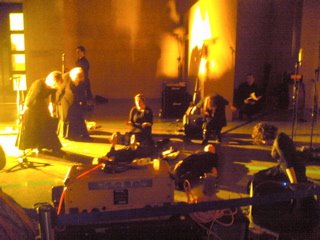
Those who know me will attest to my "heathen" approach to the Arts perhaps best characterised by my (only slightly sweeping) generalisation that "poetry is crap" from my early 80's period.
So, who else better to report on some Performance Art witnessed first hand on Saturday at the Tate Britain by Linder entitled "The Working Class Goes to Paradise"? The fact that the performance was on April 1st added to my suspiciousness.
To give you a feel for the atmosphere, the music (continuous) could best be described as like being at the front-row of a Hawkwind concert, with 3 parallel-universe Hawkwinds all playing at once. Being in the environment of the Tate Britain certainly enhanced the surrealness of this experience. The volume however was truly awesome, and it was an absolute necessity to wear earplugs for nearly all the 2 hours we were able to "participate". I understood that the wonderful Health and Safety people had been concerned about numbers of people beforehand (certainly not an issue). I wonder if they had actually HEARD the performance? But, strangely (perhaps), it was not unpleasant or dischordant, just excruciatingly loud.
But of course, the music is only part of the performance. As described in the Tate Britain link, "women performed movements drawn from 18th Century Shaker manuals". Now, I didn't know a whole lot about Shakers, but here I've saved you the small job of Googling with this little piece that is relevant. In fact, this link explained one part which was getting me confused - namely the arrival of a person who was obviously a woman (and I suspect is indeed Linder) but who had a main of hair protruding from the rear, a costume that had elements of medieval times as well as the Wild West (there were also several images of Clint Eastwood around, but don't ask me why), and a nice beard/moustache set. She had also (in another rumour I heard) fasted for 10 days before the performance. She then did a long period of touching of hands/heads etc on some of the other women, which included extensive and (I would guess, exhausting) shaking. It is now (reasonably) clear to me that Linder (if indeed it was she) was in fact portraying the Shaker character of Ann Lee who (according to the link I have provided you) had a revelation during a long imprisonment that she was the Second Coming of Christ.
Unfortunately, I had only my cameraphone with me, and the photos are particularly poor. So the best you will get from me to give you an idea of the ambience is the one included here at very low resolution.
So, the verdict? Well, it was actually strangely compelling. Of course, I understand about 1% of the significance of any aspect of the performance. I still do not really understand the Workers in Paradise title. I think it is possible to equate the Shaker movement with the working class struggle perhaps, but I can't quite reconcile paradise and a continuous Hawkwind concert, though I can think of a venue much lower down that might be more appropriate!
As an aside, you may be wondering how arts heathens such as myself get invites to such events. The link in this is our old friend Dr Bob who is unique in this world in having worked in the same employment as (my partner) Sue (while gaining his PhD) AND me (while at Tibco). Bob was official Scientist for the event and as such seemed to be responsible for recording the proceedings in a written form. I hope your hearing is still fully functional, Bob. And, perhaps you could let me know what your findings are?
The 21st Century Judiciary?
Perhaps 20 years ago, in an English courtroom one could imagine the following conversation:
Judge: Who or What are these "Beatles" that you are talking about?
Barrister: They are, I understand, a popular beat combo, m'lud.
So, it is with amusement and pleasure that I read of the following proceedings in the Apple vs Apple case (from Associated Press via CNN):
Not just a computer-using and iPod-using judge, but one who uses a computer with a market share of 2-3%? A sign of the times indeed. I wonder whose music is on his iPod?
Judge: Who or What are these "Beatles" that you are talking about?
Barrister: They are, I understand, a popular beat combo, m'lud.
So, it is with amusement and pleasure that I read of the following proceedings in the Apple vs Apple case (from Associated Press via CNN):
The case is being heard by Edward Mann, a computer-literate judge who has acknowledged owning an iPod music player.
At one point Thursday he stopped Grabiner during the lawyer's explanation of Apple Computer's iLife software suite.
"ILife is not a complete novelty to me. I've got it and I use it," the judge said.
Grabiner apologized for explaining the obvious, but said that should the case go to a higher court, an older judge might not be so savvy.
Not just a computer-using and iPod-using judge, but one who uses a computer with a market share of 2-3%? A sign of the times indeed. I wonder whose music is on his iPod?
31 March 2006
MP3 Player Marketing Strategy
Marketing Guru Dogbert has hit upon the way other manufacturers can take a swipe at the iPod's success. The strips leading up to this one nicely set the scene, starting here.
(I don't regularly look at Dilbert these days, but every so often someone sends me a link and I find it hilarious. I don't know how Scott Adams has managed to maintain this level of output over the years, but I'm sure glad he has).
(I don't regularly look at Dilbert these days, but every so often someone sends me a link and I find it hilarious. I don't know how Scott Adams has managed to maintain this level of output over the years, but I'm sure glad he has).
Another Sony Mistake
Lots of stories today about the apparent demise of Sony's UMD format.
I was always incredulous that such a unique and proprietary format could ever take off. The omens were not good following criticism of the PSP's video capabilities as I pointed out in this post back in October last year. The editorial in PSPWorld magazine I linked to in that article is worth re-reading as the author displays an excellent understanding of the PSP weaknesses (including use of UMD).
If Apple expected people to put a separate card in an iPod to play different bits of video, what would the world have thought? This is yet another example of muddied thinking through vertical integration that has gone too far. Sony can only ever retrieve it's Consumer Electronics crown if it accepts that creating and owning the content are not compatible with innovation in consumer gadgets. It must split the business as soon as it can. It should have been the portable music player leader, but ATRAC and other associated mistakes cost it dearly there. The Rootkit debacle was also a consequence of it's content ambitions, and now UMD. With Blu-ray it cannot afford to mess up, but I wouldn't bet against Sony turning out to be it's worst enemy on that too.
I was always incredulous that such a unique and proprietary format could ever take off. The omens were not good following criticism of the PSP's video capabilities as I pointed out in this post back in October last year. The editorial in PSPWorld magazine I linked to in that article is worth re-reading as the author displays an excellent understanding of the PSP weaknesses (including use of UMD).
If Apple expected people to put a separate card in an iPod to play different bits of video, what would the world have thought? This is yet another example of muddied thinking through vertical integration that has gone too far. Sony can only ever retrieve it's Consumer Electronics crown if it accepts that creating and owning the content are not compatible with innovation in consumer gadgets. It must split the business as soon as it can. It should have been the portable music player leader, but ATRAC and other associated mistakes cost it dearly there. The Rootkit debacle was also a consequence of it's content ambitions, and now UMD. With Blu-ray it cannot afford to mess up, but I wouldn't bet against Sony turning out to be it's worst enemy on that too.
29 March 2006
France and DRM
I've been struggling to understand what exactly it is that the French parliament has done. Most articles I've seen have focussed almost entirely on the impact on the Apple/iPod/iTunes business. Of course, the law is not about that per se.
There appears to be a lot of rejoicing people as well - those who think it means the end of DRM, and those who'd like to stop an Apple monopoly in music from taking hold (though I haven't heard the same arguments applied to stopping the Microsoft monopoly that actually exists and harms). Anything that has those two camps together has got to be suspect!
I came across this article in Tidbits yesterday by Kirk McElhearn who resides in France. It is the best article I've read on the subject and raises many interesting points, and is pretty fairly written.
The FT's Lex also had some interesting things to say about it (though even Lex concentrated on the Apple element). A subscription is required for the full article but this highlight seemed very true:
Before the anti-DRM brigade get too carried away though, it is worth them exploring what open source developers in France have said about the law (they are horrified). This article from Infoworld is useful reading.
I would be very sceptical that this is a law brought in to help consumers. That is rarely the way things work in France. It is more likely to protect it's own industries (stand up Vivendi) and culture. Remember that this is a country that levies significant taxes on every blank CD sold (so damn you if you want to back up your hard drive or your photo collection). That's not an action of a pro-consumer nation. And I would also be very wary in general of any law that is brought in by politicians that relates to technology.
If this ever makes it to the statute books in anything like it's current form, look for people to rue the decision in a few years time when it will have hurt France's software industry, hurt the consumer, held back innovation, and held back the old industries from doing what they really should be doing, leaving France with more dinosaur corporations.
I would have preferred if, instead of looking to put limits and controls on DRM, the legislators looked at the fundamental problem of fair use and copyright in general. If that is addressed first, it is much easier to look at the DRM needed to make that work, and how it can be made universal (eg DRM conversion). The source of the problem is still with the way copyrights are handled which provides a single distribution monopoly (which is given out on a country by country basis in Europe despite the laws of the single market). This has not kept pace with what technology can offer and causes severe problems everytime a disruptive technology comes along (starting with the piano roll and including tape recording and video recording). The only winners from France's actions will be the (very) short term profits of the entertainment companies.
There appears to be a lot of rejoicing people as well - those who think it means the end of DRM, and those who'd like to stop an Apple monopoly in music from taking hold (though I haven't heard the same arguments applied to stopping the Microsoft monopoly that actually exists and harms). Anything that has those two camps together has got to be suspect!
I came across this article in Tidbits yesterday by Kirk McElhearn who resides in France. It is the best article I've read on the subject and raises many interesting points, and is pretty fairly written.
The FT's Lex also had some interesting things to say about it (though even Lex concentrated on the Apple element). A subscription is required for the full article but this highlight seemed very true:
The risk is that the proposed legislation proves too blunt an instrument. In such a fast-moving industry it could have unforseen affects on many different companies and possibly on innovation in general. Better to encourage innovative companies by protecting their intellectual property and letting the market work it out. If that fails, and dominant companies start to abuse their power, competition authorities should intervene aggressively. Apple is not there yet.
Before the anti-DRM brigade get too carried away though, it is worth them exploring what open source developers in France have said about the law (they are horrified). This article from Infoworld is useful reading.
I would be very sceptical that this is a law brought in to help consumers. That is rarely the way things work in France. It is more likely to protect it's own industries (stand up Vivendi) and culture. Remember that this is a country that levies significant taxes on every blank CD sold (so damn you if you want to back up your hard drive or your photo collection). That's not an action of a pro-consumer nation. And I would also be very wary in general of any law that is brought in by politicians that relates to technology.
If this ever makes it to the statute books in anything like it's current form, look for people to rue the decision in a few years time when it will have hurt France's software industry, hurt the consumer, held back innovation, and held back the old industries from doing what they really should be doing, leaving France with more dinosaur corporations.
I would have preferred if, instead of looking to put limits and controls on DRM, the legislators looked at the fundamental problem of fair use and copyright in general. If that is addressed first, it is much easier to look at the DRM needed to make that work, and how it can be made universal (eg DRM conversion). The source of the problem is still with the way copyrights are handled which provides a single distribution monopoly (which is given out on a country by country basis in Europe despite the laws of the single market). This has not kept pace with what technology can offer and causes severe problems everytime a disruptive technology comes along (starting with the piano roll and including tape recording and video recording). The only winners from France's actions will be the (very) short term profits of the entertainment companies.
27 March 2006
Beautiful Kerala
I've now had a chance to store and organise (if not edit and process) the large number of photos I took on our holiday. I've posted a small selection of these up on my personal website as a slideshow.
I'm also going to photocast a photo every day or so, which you can subscribe to in your RSS reader.
If you're not familiar with Kerala (and I expect that's the vast majority of people visiting here), it's a medium-sized state in the South of India, described by various publications as follows:
I have to say these comments are not hyperbole. The landscapes were glorious - everywhere we went. The people, as always in India, were wonderful and friendly. Our food was superb EVERY time - from takeaway Veg Biryani to multiple course sit-down meals. Washed down with a Kingfisher beer of course. Our accommodations were all memorable, with each providing a different vantage point for understanding the country. These ranged from a massive 3-bed bungalow in a tea plantation, to a 2-bed houseboat, to a 250 year old guest house on the beach (with one night in the most luxurious tent I've ever been in complete with ensuite bathroom and hot water!). It also boasts a 99% literacy rate - better than anywhere else in India (and indeed many developed countries).
As an aside, all of this was researched and booked online - the trip and the flights, including checking in. Not a single phone call was needed beforehand. Responses to emails and enquiries was always fast (even from India).
Special credit to both www.responsibletravel.com through whom we found this holiday and booked it, and especially to Kalypso Adventures (www.kalypsoadventures.com) - ex-Commanders Sam Samuel and Thomas Zacharias for designing and operating such a wonderful experience. And, not forgetting Bhinu, our guide and cycling companion, and Das, who was there with bananas and water when we needed it (and made sure we and our luggage got safely to each point when in the vehicle)!
I'm also going to photocast a photo every day or so, which you can subscribe to in your RSS reader.
If you're not familiar with Kerala (and I expect that's the vast majority of people visiting here), it's a medium-sized state in the South of India, described by various publications as follows:
One of the 50 must see destinations of a lifetime - " National Geographic Traveler"
One of the 10 paradises of the World - " National Geographic Traveler "
One of the 100 great trips for the 21st century - " Travel and Leisure "
One of the ten hot spots for the millennium - " Emirates In-flight Magazine "
One of the ten love nests in India - " Cosmopolitan "
One of the six destinations of the millennium - " Khaleej Times "
I have to say these comments are not hyperbole. The landscapes were glorious - everywhere we went. The people, as always in India, were wonderful and friendly. Our food was superb EVERY time - from takeaway Veg Biryani to multiple course sit-down meals. Washed down with a Kingfisher beer of course. Our accommodations were all memorable, with each providing a different vantage point for understanding the country. These ranged from a massive 3-bed bungalow in a tea plantation, to a 2-bed houseboat, to a 250 year old guest house on the beach (with one night in the most luxurious tent I've ever been in complete with ensuite bathroom and hot water!). It also boasts a 99% literacy rate - better than anywhere else in India (and indeed many developed countries).
As an aside, all of this was researched and booked online - the trip and the flights, including checking in. Not a single phone call was needed beforehand. Responses to emails and enquiries was always fast (even from India).
Special credit to both www.responsibletravel.com through whom we found this holiday and booked it, and especially to Kalypso Adventures (www.kalypsoadventures.com) - ex-Commanders Sam Samuel and Thomas Zacharias for designing and operating such a wonderful experience. And, not forgetting Bhinu, our guide and cycling companion, and Das, who was there with bananas and water when we needed it (and made sure we and our luggage got safely to each point when in the vehicle)!
Subscribe to:
Posts (Atom)