A couple of notes about Jon Stewart's The Daily Show (which, Charles, I know is on Freeview More4 - channel 13 - at 8.30pm most weekday nights, but I'd still like to be able to buy some shows from iTunes!).
Today, "scientific" research has been reported via Ars Technica proving that The Daily Show's news content is as substantive as "real news" (but also a whole lot funnier)!
Last week, Jon got the scoop with an interview with President Pervez Musharraf of Pakistan! I can't imagine Tony Blair being interviewed on this, and neither would he come off as cleverly as did Musharraf. It was better and more enlightening than most other political interviews I've seen in recent years.
Do yourself a favour and watch the Monday night highlights - World Edition - from the previous week's shows! 20 minutes very well spent.
Tags: The Daily Show with Jon Stewart
05 October 2006


The Weather
Back when we had the scorcher in July, my blogging friend otan2 beat me to the punch with this post noting how much higher the average temperature had been for the WHOLE of July in Scotland. I commented that the England figure was slightly higher still at 3.6Celsius over normal.
August of course was a different kettle of fish entirely - a real washout and disappointment. But strangely, the average temperature in England was still above normal - though only just. Given one of the worst Augusts that I can remember, that was amazing to me.
Now the September figures are in, and once again the month was 3.2C above the normal average in England and Wales.
These are statistically massive variations, and we should be very worried indeed by the range of variation and especially that even cool wet months are warmer than typical good summer months.
While I know that this is just the English weather and doesn't get too much attention outside these shores, I'm assuming these extremes are being regularly repeated elsewhere around the globe. George Bush: How many Katrinas is it going to take for you to wake up? (or to put it in a completely different American-only context: Do you not think the negative influences of states like Iran and Venezuela would fade if America made major strides to reduce its dependence on oil?).
Tags: Climate, Kyoto, UK Met Office
August of course was a different kettle of fish entirely - a real washout and disappointment. But strangely, the average temperature in England was still above normal - though only just. Given one of the worst Augusts that I can remember, that was amazing to me.
Now the September figures are in, and once again the month was 3.2C above the normal average in England and Wales.
These are statistically massive variations, and we should be very worried indeed by the range of variation and especially that even cool wet months are warmer than typical good summer months.
While I know that this is just the English weather and doesn't get too much attention outside these shores, I'm assuming these extremes are being regularly repeated elsewhere around the globe. George Bush: How many Katrinas is it going to take for you to wake up? (or to put it in a completely different American-only context: Do you not think the negative influences of states like Iran and Venezuela would fade if America made major strides to reduce its dependence on oil?).
Tags: Climate, Kyoto, UK Met Office
Boris Johnson - Eccentric or Prat?
Those who know me, know that I am NOT a Tory - at least of the Thatcher kind. I sit somewhere in the middle ground - perhaps a ground that used to be occupied by the Lib Dems until they lost touch with reality. Neither am I a supporter of privileged private school educations - especially Eton.
So, on the surface, I should think that Boris Johnson is a complete idiot who represents the worst type of private-school delusional right wing views imaginable.
Recently, Boris has come under sustained fire for a number of "gaffes", encapsulated here in the Guardian recently.
William Hague - former Tory leader for my American friends - called him eccentric in a niceish way.
But I actually think "eccentric" is an unfair term and shows just how politically correct our politics have become, stifling debate because we won't call a spade a spade. Do we have to label people as eccentric just because they say something controversial. Boris may be eccentric, but not for much of what's he's said.
A couple of years ago, Boris was forced to eat humble pie in Liverpool after criticising the people for wallowing in "disproportionate grief" over the murder of Ken Bigley in Iraq. But, Boris was absolutely right. I am, of course, a scouser, and therefore able so say such things (another indication of our politically correct society when only a person of that group is allowed to criticise it). Liverpool is a wonderful place, and there are wonderful people there. But for too long it HAS wallowed in self-pity. It would rather receive handouts than do what it has to (I can list a few other parts of the UK similarly). I made my decision as a teenager to get the hell out of there, and I have no regrets. Score 1 to Boris.
Now, Boris also got criticised for making remarks about that wonderful pillar of the establishment, Jamie Oliver. So much so, that the Tories were forced into allocating time at their conference to introduce an emergency motion praising Mr Oliver. Whether you support Jamie's school dinners campaign or not (is there ANYONE who is against in an argument that goes something like "would you like good, wholesome school dinners, or crap?"), one can't help thinking that Mr Oliver's own self-publicity had just a little to do with the whole scheme. The people who should be praised are those who have fought unsung for such changes since times when Jamie Oliver was himself still at school. But who are, of course, ignored by the very media who will only give the airtime to a celebrity.
Politics needs Boris Johnson like it needs Tony Benn, Tam Dalyell, and, dare I say it, Anne Widdecomble to name a few. Heh, maybe even that dour Jack Straw could make it into that group if he continues to say what needs to be said.
And, I'll take the Tories more seriously when they don't resort to spin to protect the reputation of a celebrity who is quite capable of looking after himself.
Boris, I'm not going to agree with you on many things, but on the prat vote, Jamie Oliver wins over you anytime. And, you may be eccentric, but not because of these things. Keep speaking out!
So, on the surface, I should think that Boris Johnson is a complete idiot who represents the worst type of private-school delusional right wing views imaginable.
Recently, Boris has come under sustained fire for a number of "gaffes", encapsulated here in the Guardian recently.
William Hague - former Tory leader for my American friends - called him eccentric in a niceish way.
But I actually think "eccentric" is an unfair term and shows just how politically correct our politics have become, stifling debate because we won't call a spade a spade. Do we have to label people as eccentric just because they say something controversial. Boris may be eccentric, but not for much of what's he's said.
A couple of years ago, Boris was forced to eat humble pie in Liverpool after criticising the people for wallowing in "disproportionate grief" over the murder of Ken Bigley in Iraq. But, Boris was absolutely right. I am, of course, a scouser, and therefore able so say such things (another indication of our politically correct society when only a person of that group is allowed to criticise it). Liverpool is a wonderful place, and there are wonderful people there. But for too long it HAS wallowed in self-pity. It would rather receive handouts than do what it has to (I can list a few other parts of the UK similarly). I made my decision as a teenager to get the hell out of there, and I have no regrets. Score 1 to Boris.
Now, Boris also got criticised for making remarks about that wonderful pillar of the establishment, Jamie Oliver. So much so, that the Tories were forced into allocating time at their conference to introduce an emergency motion praising Mr Oliver. Whether you support Jamie's school dinners campaign or not (is there ANYONE who is against in an argument that goes something like "would you like good, wholesome school dinners, or crap?"), one can't help thinking that Mr Oliver's own self-publicity had just a little to do with the whole scheme. The people who should be praised are those who have fought unsung for such changes since times when Jamie Oliver was himself still at school. But who are, of course, ignored by the very media who will only give the airtime to a celebrity.
Politics needs Boris Johnson like it needs Tony Benn, Tam Dalyell, and, dare I say it, Anne Widdecomble to name a few. Heh, maybe even that dour Jack Straw could make it into that group if he continues to say what needs to be said.
And, I'll take the Tories more seriously when they don't resort to spin to protect the reputation of a celebrity who is quite capable of looking after himself.
Boris, I'm not going to agree with you on many things, but on the prat vote, Jamie Oliver wins over you anytime. And, you may be eccentric, but not because of these things. Keep speaking out!
Too Quiet
Sorry it's been a bit quiet here. I lost the will to live a bit after Charles' last comments! (only joking - just the will to blog!). But I've been working on a Hobsblog vs Guardian riposte, and it will be here real soon. In the meantime, I've posted some views on mp3 phones - following a (dire) review of an LG model. Let me know what you think on these. Do you love your music phone? Has it replaced an iPod or similar device? How well does all the software work in terms of keeping it in sync? How well does it fit into other aspects of your life - gym usage, car usage, home usage, etc? And, have you bought music with it? If so, how was that experience?
A couple of other brief stories that have got my attention recently will also be posted shortly!
A couple of other brief stories that have got my attention recently will also be posted shortly!
How not to make an mp3 phone...
Excellent review/case study by Joel Spolsky on his experience with an LG phone from Sprint (via Daring Fireball link).
I'm not going to say that ALL mp3 phones are as bad as this - I know they're not. But when faced with simple stats like "100million phones sold with music players built in", it's important to remember that the vast majority of them have not been bought with that as the major feature, and also that it is highly doubtful that the vast majority of such phones are regularly being used for music (or other multimedia).
Joel highlights some of the fundamental problems here - the manufacturer and the network operator with misaligned business objectives being key. While the networks are struggling to find revenues to pay off their foolish investments in 3G, others are going to come from behind and deliver a compelling mobile strategy that makes sense. The networks don't get the internet, and nor do they get media. While their thinking is focused on how to use and ringfence that network to maximise revenues, others can come along with a clean slate and deliver a mobile strategy that is integrated, affordable and genuinely compelling.
What could a company without the ties of a network operator do differently?
1. Supply a multi-network phone that worked and that didn't try to force you into using an expensive data network all the time. By this I mean a phone that automatically picked up Wi-Fi (WiMAX? and other) networks first for its default connection.
2. Provided VoIP client and IM on the phone - eg through a Skype partnership and/or the Gizmo (SIP) approach. Make it work as cheaply as possible (eg using wifi when it can), giving you the option to switch manually or automatically into higher cost networks depending on availability.
3. Easily let you manage your data connections between free and paid.
4. Supply content to the phone as part of an overall strategy of supplying content to ALL your devices.
5. Provided a number of additional services - free/ad-supported/paid that genuinely added value to the device and encouraged use - both on the device itself and on your other devices.
6. Support access to your normal email service in a synchronised way and possibly access to your data via a virtual hard disk (or vpn to a server).
Who could do all of this? Well, Nokia can today. But something seems to be stopping Nokia from completing the picture. My guess is that it is the networks themselves, who, after all, are Nokia's customers in reality (not you and me). While most of the pieces are there on current high end Nokia phones, and the reality is much better than Joel's review, things are still a bit all over the place. My phone for instance always establishes an orange data connection after being switched on (which is often the case because it switches off frequently of its own accord!) without giving me a chance to stop it. Fortunately, I don't have any apps running that take the data, but it is annoying to find a data connection active. Also, I can't turn wi-fi off and save battery. If there's a wifi network I've setup, the phone detects it when within range. Experiences with the music player and media player leave a lot to be desired.
I'm sure Sony Ericsson is up to the task too, but has the same problems as Nokia. Motorola, while making the best looking phones at this time, doesn't seem to understand UI, so I'm not sure about them.
I know which company you think I'm going to suggest, but actually you're wrong! Microsoft is the company that had most to offer in this area and had the capability to deliver it. It is far less tied in to the network operators than Nokia and the other manufacturers, it had much of the technology in place with Windows Mobile, and with all it's back end infrastructure - MSN, WindowsLive etc, probably could have delivered some compelling services (finally finding a way to monetise MSN better). And Microsoft also has/had the resources to throw money at this area. It could probably have found good partners in the network operators that are least successful, and/or piggy-backed on a good virtual network operator. In the UK for instance, could a Microsoft-BT partnership or a Microsoft-Virgin partnership not delivered a compelling mobile service? It probably wouldn't have faced huge regulatory hurdles because there is lots of competition already and a dynamic space.
Instead, Microsoft has focused on XBox, and, now on trying to hurt the iPod. It may well have defeated Sony in the games market - time will tell. But if so, I think that's more down to Sony's rash of disastrous mistakes and poor execution. By the time they land significant punches on the iPod, I think the world will have moved on.
Sure, they will no doubt be working on a Zune phone etc. and you might make the (fair) argument that they've still not worked out how to be a hardware company, but I really think this is a space they could have owned or at least muscled into a strong position next to Nokia and the like.
So that brings me to the company you first thought I was going to say! Of the other capable companies out there, only Apple has the design skills to bring all this together. But Apple doesn't have at least two things that Microsoft has. It doesn't have a phone OS. Symbian and Windows Mobile have both cost huge amounts to develop, and this is not a trivial problem to overcome. Perhaps Apple has something up their sleeves, or perhaps it will do a deal with Symbian or somebody (though that is quite un-Apple-esque).
Neither does Apple have a great services strategy. Sure, it can deliver media content and that is one of its compelling angles in this space. But in services it is WAY behind others. .Mac I find useful, but it is certainly not free and not for everyone. And, it doesn't offer many of the things that people like Yahoo, Microsoft and, of course, Google bring.
I touched on this when talking about Eric Schmidt joining Apple's board, but it is increasingly clear to me that Apple's next push will be into the mobile space and that it will do this with Google's help. Google has a lot to gain by getting searches done on mobile devices and increasingly using its location services. To say nothing of GMail, Blogger.com, GoogleTalk, Picassa, GoogleGroups, Calendar etc. It must be frustrated that such services are not being used by mobile users more frequently. Only Google has the clout to provide many of these data services for free or at least at low-cost. It might even be able to make a dent in handset costs too - given that most people pay nothing or close to nothing for their handsets due to subsidies, this is another obstacle Apple and Google will have to overcome.
If I was a network operator, I'd be courting these guys very closely, no matter how successful I currently was. But for turnaround situations (eg Softbank in Japan who took over Vodafone's failing service) or virtual network operators (Virgin, BT), it is a no-brainer.
I used to think that Apple had no chance in this space and wouldn't try. But how things have opened up through greed and incompetence. And, Microsoft, who could have seized this easily, will as usual be playing catch up from behind by throwing money at it until their dominance is established.
Tags: Apple, Microsoft, LG, Nokia, Sony Ericsson
I'm not going to say that ALL mp3 phones are as bad as this - I know they're not. But when faced with simple stats like "100million phones sold with music players built in", it's important to remember that the vast majority of them have not been bought with that as the major feature, and also that it is highly doubtful that the vast majority of such phones are regularly being used for music (or other multimedia).
Joel highlights some of the fundamental problems here - the manufacturer and the network operator with misaligned business objectives being key. While the networks are struggling to find revenues to pay off their foolish investments in 3G, others are going to come from behind and deliver a compelling mobile strategy that makes sense. The networks don't get the internet, and nor do they get media. While their thinking is focused on how to use and ringfence that network to maximise revenues, others can come along with a clean slate and deliver a mobile strategy that is integrated, affordable and genuinely compelling.
What could a company without the ties of a network operator do differently?
1. Supply a multi-network phone that worked and that didn't try to force you into using an expensive data network all the time. By this I mean a phone that automatically picked up Wi-Fi (WiMAX? and other) networks first for its default connection.
2. Provided VoIP client and IM on the phone - eg through a Skype partnership and/or the Gizmo (SIP) approach. Make it work as cheaply as possible (eg using wifi when it can), giving you the option to switch manually or automatically into higher cost networks depending on availability.
3. Easily let you manage your data connections between free and paid.
4. Supply content to the phone as part of an overall strategy of supplying content to ALL your devices.
5. Provided a number of additional services - free/ad-supported/paid that genuinely added value to the device and encouraged use - both on the device itself and on your other devices.
6. Support access to your normal email service in a synchronised way and possibly access to your data via a virtual hard disk (or vpn to a server).
Who could do all of this? Well, Nokia can today. But something seems to be stopping Nokia from completing the picture. My guess is that it is the networks themselves, who, after all, are Nokia's customers in reality (not you and me). While most of the pieces are there on current high end Nokia phones, and the reality is much better than Joel's review, things are still a bit all over the place. My phone for instance always establishes an orange data connection after being switched on (which is often the case because it switches off frequently of its own accord!) without giving me a chance to stop it. Fortunately, I don't have any apps running that take the data, but it is annoying to find a data connection active. Also, I can't turn wi-fi off and save battery. If there's a wifi network I've setup, the phone detects it when within range. Experiences with the music player and media player leave a lot to be desired.
I'm sure Sony Ericsson is up to the task too, but has the same problems as Nokia. Motorola, while making the best looking phones at this time, doesn't seem to understand UI, so I'm not sure about them.
I know which company you think I'm going to suggest, but actually you're wrong! Microsoft is the company that had most to offer in this area and had the capability to deliver it. It is far less tied in to the network operators than Nokia and the other manufacturers, it had much of the technology in place with Windows Mobile, and with all it's back end infrastructure - MSN, WindowsLive etc, probably could have delivered some compelling services (finally finding a way to monetise MSN better). And Microsoft also has/had the resources to throw money at this area. It could probably have found good partners in the network operators that are least successful, and/or piggy-backed on a good virtual network operator. In the UK for instance, could a Microsoft-BT partnership or a Microsoft-Virgin partnership not delivered a compelling mobile service? It probably wouldn't have faced huge regulatory hurdles because there is lots of competition already and a dynamic space.
Instead, Microsoft has focused on XBox, and, now on trying to hurt the iPod. It may well have defeated Sony in the games market - time will tell. But if so, I think that's more down to Sony's rash of disastrous mistakes and poor execution. By the time they land significant punches on the iPod, I think the world will have moved on.
Sure, they will no doubt be working on a Zune phone etc. and you might make the (fair) argument that they've still not worked out how to be a hardware company, but I really think this is a space they could have owned or at least muscled into a strong position next to Nokia and the like.
So that brings me to the company you first thought I was going to say! Of the other capable companies out there, only Apple has the design skills to bring all this together. But Apple doesn't have at least two things that Microsoft has. It doesn't have a phone OS. Symbian and Windows Mobile have both cost huge amounts to develop, and this is not a trivial problem to overcome. Perhaps Apple has something up their sleeves, or perhaps it will do a deal with Symbian or somebody (though that is quite un-Apple-esque).
Neither does Apple have a great services strategy. Sure, it can deliver media content and that is one of its compelling angles in this space. But in services it is WAY behind others. .Mac I find useful, but it is certainly not free and not for everyone. And, it doesn't offer many of the things that people like Yahoo, Microsoft and, of course, Google bring.
I touched on this when talking about Eric Schmidt joining Apple's board, but it is increasingly clear to me that Apple's next push will be into the mobile space and that it will do this with Google's help. Google has a lot to gain by getting searches done on mobile devices and increasingly using its location services. To say nothing of GMail, Blogger.com, GoogleTalk, Picassa, GoogleGroups, Calendar etc. It must be frustrated that such services are not being used by mobile users more frequently. Only Google has the clout to provide many of these data services for free or at least at low-cost. It might even be able to make a dent in handset costs too - given that most people pay nothing or close to nothing for their handsets due to subsidies, this is another obstacle Apple and Google will have to overcome.
If I was a network operator, I'd be courting these guys very closely, no matter how successful I currently was. But for turnaround situations (eg Softbank in Japan who took over Vodafone's failing service) or virtual network operators (Virgin, BT), it is a no-brainer.
I used to think that Apple had no chance in this space and wouldn't try. But how things have opened up through greed and incompetence. And, Microsoft, who could have seized this easily, will as usual be playing catch up from behind by throwing money at it until their dominance is established.
Tags: Apple, Microsoft, LG, Nokia, Sony Ericsson
19 September 2006
(Old) Football News...
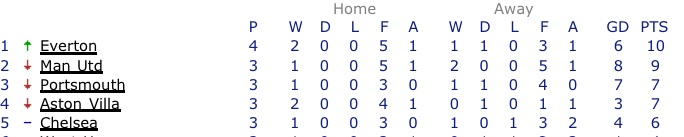
I've been a bit late in reporting on this - general tardiness combined with the hope that last Saturday things were going to get even better. But a 2-2 draw with Wigan ruined that hope and the brief top of the table stint from the previous weekend was not repeated.
Nevertheless, I would just like to trumpet the performance of Everton in the first few games of this season and in particular, to celebrate the 3-0 defeat of arch-rivals Liverpool - the best scoreline seen since 1964 (which pre-dates my memory, if not support). Well done David Moyes and team!
If only the glory days of the late sixties and the mid-eighties could be recaptured!
Tags: Everton FC
Guardian, Apple, iTV and Ignorance
Charles referring to my article on the new Apple announcements (and specifically about my criticism of the Guardian) posted in the comments to that article the following which I'm reprinting so it doesn't get lost:
This article is VERY long and represents a detailed piece of research and writing that I've conducted in order to answer Charles' criticisms.
First of all, I would acknowledge (and did acknowledge in the article) that it was a QUICK reaction to that day's news and I apologise for not posting the usual links that I do. At the time, the only Guardian commentary was from Victor Keegan to my knowledge which was featured heavily on the Guardian site. There was no intention for it to be "a clever way of disagreeing without having to do the difficult stuff, like being specific." But now as you ask....
(Before I launch into this, I should point out that my research has been hampered by the inability of me to browse parts of the Guardian weblog using either Safari or Firefox; at the time I tried - selecting the category Apple, Safari would freeze completely and had to be force-quitted; the behaviour was repeated 3 times before I moved on to Firefox; with this, cpu use went to 100%, and the display was quite garbled; after numerous attempts, I was able to copy and paste Charles' post so I could look at it in more detail and/or get to the permalinks. I've never had this experience with Safari before or Firefox. Is this another subtle anti-Apple ploy by the Guardian or just incompetence in adhering to web standards?)
Let's take all the articles one correspondent at a time and expose the ignorance:
First off, Victor Keegan, whose remarks were the only ones I'd seen at the time of my first article. I know Victor's not anti-Apple per se - I think he was the only journalist I know who praised the Motorola iTunes phone which even Steve Jobs is rumoured to believe was a POS. But...."Every Empire Crumbles" tagline "Apple is losing its hip and unpredictable edge as it risks being left behind by the very technology it helped to proliferate"?
Just what is the basis for this? It seems like a follow-on to the previous Sunday's Observer full one pager in the MAIN paper saying that the iPod was no longer cool. You know, Guardian/Observer Group, if you write it enough, you will believe it.
But what is Victor's evidence of the decline of the empire? It's not Apple's stock price obviously, or their recent financial performance (the last quarter of which had revenues up 24% over last year and 117% over 2 years ago). Neither of which are mentioned. It's not Apple's market share of music players, which is not mentioned. Instead, Victor uses 2 quarters of consecutive sales drops on iPods and refers to the number of mobile phones sold which have music playing capabilities. I wonder if it had anything to do with the fact that Christmas comes but once a year, and that last year, new nanos AND 5G iPods had been introduced in that quarter causing a truly huge leap in iPod sales resulting in a baseline from which consecutive drops were inevitable. If Apple had not expected this, it would be sitting on huge inventory which it would now be writing off. Instead iPod sales in the last quarter were 32% ahead of the same quarter in the previous year. Hardly an empire crumbling.
But what about Victor's point on mobile phones with media player capabilities? Just because a mobile phone has a built-in media player, does not mean its being used in that way. If mobile phones had crept up and taken over the iPod mantle, would we not be seeing a massive drop in iTunes share of music downloads? I know many people with mp3-capable mobile phones, and the vast majority do NOT use the music player capabilities. Of course, that may change, and Apple knows that and has admitted that. It has a huge chasm to cross, but since the mobile phone manufacturers and the operators have collectively failed to find a business model that works for both of them, there is still a gap for someone to come along who does it right.
To Victor: If this holiday season's iPod sales fall significantly below last year's, then maybe you're on to something. If the iTunes music store nosedives in its sales, then maybe you're on to something. If some other music players get into 2 of the top 5 best sellers on Amazon UK (let alone Amazon US), then maybe you're on to something. But at this time, your story is without foundation.
Let's move on. I wouldn't normally bother with Jack Schofield as we all know he hasn't a clue and writes the most ridiculous anti-Apple comments. But let's just focus on some of the stupid things he says (and believes) about Apple's announcements and what's out there from the company behind the market-leading, virus-ridden OS.
First off, Jack comments on Zune - as pre-announced as the iTV product, but with less detail. We don't know the price and we don't even know whether it works in the Plays-for-(un)sure universe, though the answer to the latter appears to be an unbelievable "NO". There is not a single criticism of Zune in Jack's piece, nor even some critical questioning. What about battery life? What about price - originally the 30GB was rumoured at $399, then matching the 30GB iPod at $299. But then Steve went and dropped the price of both 5G iPods (something no Guardian commentator noted in any article I saw) so, it will now have to be $249 surely? No questioning of the music sharing feature which seems (from what I read) to be very limited - even assuming you run into another Zune-carrier. No questioning of Plays-for-Sure. Jack, can you not think of ANY faults with this device or Microsoft's strategy?
Then Jack talks about iTV in "How much is a Media Center PC, Bobbie". Jack makes numerous points to show how far Apple is behind. He quotes media centre PC's being available for $399, then goes on to say that the iTV is not a media centre PC. So why mention the comparison, Jack? Then he says that "Media Center capability is built into Windows Vista, so most standard PCs next year will be Media Centers too." Yes, indeed, Jack, key words "next year". And, actually it is not buit into Windows Vista, it is built into the more expensive versions of Windows Vista. If you buy a machine today (assuming it can really handle full-blown Vista next year), then expect to pay another $159 just for the software - that's half the price of an iTV before any hardware is considered. And, we're mixing the future with today, yet again. How many media centre PCs are even four times the size of the iTV? How many are quiet? How many can sit in your living room and look the part?
Jack then talks about the Linksys Media Centre extender, a device which costs a similar amount to Apple's proposed list price for iTV at $313 according to my searches. Jack calls it "similar". Well, perhaps it's closer in looks to the iTV than any of the media center PC's he talks about. But, the Linksys doesn't do HD, nor does it do H.264. Both of these are very demanding applications requiring state-of-the-art chips. Neither does the Linksys have a HD port - either DVI or HDMI. The iTV has an HDMI port meaning it can provide a digital signal to a digital TV. The Linksys uses 802.11g standard. It is highly likely that the iTV will use the new 802.11n standard, and indeed a key reason why the product is not released yet, is because that standard is still not ratified, and Apple would be opening itself up for major problems if it shipped a pre-N consumer device which couldn't be made compatible with the final n standard. Jack, as always, fails to appreciate these differences. They are not mere subtleties, they are fundamental differences affecting price, delivery date, and overall user experience. Failure to read a spec sheet and/or to understand should disqualify you from writing about technology in an opinionated way.
Then, he notes the XBox360 as a media centre extender. A device significantly bigger than the iTV, with a large external power brick and reportedly high heat output (from both brick and device). Is this the device you want next to your plasma TV? Will you leave it on all the time? What about the noise from the fans? Hardly audiophile is it? Only the basic XBox360 is at an equivalent price to the iTV. And it's at that price because Microsoft loses money on everyone it sells. Sure, you could be clever and pay that and never buy a game - ha, ha, Microsoft. But if you want a media centre extender, get one that is designed for the job - not doubles up as one.
Then Jack comes up with this amazing statement
What? VIsta isn't shipping either, Jack. Same sort of timeframe as iTV for home users. And if Apple is late to the party, why is not everyone doing what you suggest with XP today? The fact is they're not, and Vista by itself is not going to solve that. And, if Microsoft thought it had it nailed, it wouldn't be converting itself to Microhard and creating its own incompatible music players, and potentially its own Microsoft phone.
Jack finishes with this final dig at Steve and Apple
What (again)? As far as I know, Apple's prices for online movies are the lowest there are. The reason they aren't lower has been well-publicised. Does Jack think that a key reason the other movie studios have not signed on for the Apple vision is because Apple priced them too HIGH? If you don't like the price, then don't buy. But, Jack completely misses or avoids the point that iTV does not force you to use the Apple movie store any more than Microsoft's MediaCenter technology forces you to use Amazon (rip a DVD, play a recorded TV show off Elgato EyeTV etc). Movie stores all have DRM, and all provide limits. Apple has been careful to come up with limits that seem at least reasonable for the typical family home situation.
Finally, let's move on to Charles himself. I like Charles, really I do. And he visits here regularly to give his comments. He's a bright guy. But he doesn't get video. Plenty of people have commented on the Guardian blog about his factual errors in this piece. But let's just cover this paragraph:
"Movies? In 640 by 480, it's a giant leap forward to 1985, and VGA, isn't it? Jobs called it "near DVD quality at 640x480 resolution". Yes, but the average TV screen roughly equates to 1024 x 768. Anything less isn't "near" DVD. It's a quarter the size. The rights will be the same as the TV shows - so no burning to disc. It's hardly terrific for a backup strategy. We think that at those prices, the likes of Netflix - and indeed Amazon - can sleep easy. When the physical product is cheaper than the virtual one, it's only a contest where people won't travel. And even then, the file-sharing networks haven't gone away."
Where to start, really. The average TV screen is certainly not 1024 x 768, though this may be the average computer monitor. The average TV screen has a resolution of something less than 576 lines in this country and 480 lines in the US. Until very recently, most top-end plasma screens sold in this country from even good names like Panasonic were 852 x 480. Oh, 480, isn't that a coincidence? Of course not, it's what NTSC is built upon. So, even top end TV's have not supported the 576 lines of real resolution offered by PAL. Resolution of 640 x 480 for videos is in theory as good as US DVD's. We can get into esoteric arguments about PAL vs NTSC (number of lines, frame rates) etc, but it doesn't belong here and has little to do with Apple's movie store. In the US, it would be relatively easy for Apple to deliver near-DVD quality with a 640 by 480 video, because the resolutions are very similar indeed. In fact, it could probably exceed DVD quality if it was able to re-master from the original using better H.264 compression than the older and less efficient MPEG2 compression used on DVDs. Most likely however, much of the material available on the store could come from DVD's converted. In which case, there would clearly be some loss going from a lossy scheme like MPEG2 to another lossy scheme like H.264. From the demos we saw on a large screen, I don't think quality will be an issue. In reality, there is massive variation between the quality of DVDs available in both NTSC and PAL (I watched a truly badly encoded Japanese movie last night on DVD). I see no reason why the choices Apple has made and with appropriate quality control should not lead to a quality output to both computer screen or to TV monitor that most people would find indistinguishable from the equivalent DVD.
In Europe (once we get such videos) maybe things are not so simple, and it will be interesting to see whether the European stores will offer different resolutions. But 640 by 480 on 30 frames a second with a progressive output and a decent quality master to start with, should again be able to provide excellent quality output to most computer monitors and TV sets (even here). To improve from this would really require a jump to High Definition. Is this what Charles wanted? But no one else offers HD movies digitally today. And, as Charles alluded to with his broadband comments, many people would find their download speeds the obstacle for true HD delivery, even if their computer could handle it, and their tv screen display it (true HD is at least 7-8 times the data size of Standard Definition TV). The point you have missed Charles, is that 640 by 480 is NOT "quarter the size", and you have given people a very bad impression because of this serious factual error. Apple's movie resolution choices are as good as any other digital delivery service available today, and their choice of H.264 probably will lead to it being better than any of them and/or with a lower file size. Furthermore, it requires just ONE download to serve computer, tv, AND iPod. Contrast with the Amazon Unboxed store which requires two files to be downloaded, stored and managed. (Most other stores to my knowledge don't even support portable devices at all) Is it for everyone? I'm sure not. I'm a rental user, and generally do not own videos. But I can see times when I would buy it this way (DVDs of concerts for instance). And, for people with kids, having a digital version may be a lot safer than a physical one. The movies can be copied to DVD, and can be copied to other hard disks. So, there IS a backup strategy - one that is arguably better than a single flimsy disk). It's not one where you can create a playable DVD directly. Whose fault is that? If you don't like the rights and you don't like the price, the way to change it is not to boycott online sales, it's to boycott ALL movie sales - physical and digital - until the studios wake up to give you products and rights on those products that are more reasonable. What Charles also doesn't mention is that with a simple cable it will be possible to watch the movies at 640 by 480 on a TV straight from the iPod (and in fact last year's 5G models too with a software upgrade). Imagine the convenience of carrying an iPod on holiday and connecting into a hotel TV? There's a convenience and simplicity about all this that IS absent from a physical product, and from other stores. Apple has made some good choices, despite the limits put on it by those studios (and by companies like Walmart who are rumoured to have threatened the studios). Another point Charles made (in his comments to my blog) is to infer that videos cannot be played until they have been downloaded. But from my interpretation of the keynote, they are available within a minute of downloading starting. That is pretty much VOD. Sure, if you've got an unreliable broadband, you may want to wait till there's a decent buffer. But I think again, Charles, you've erred in your criticism, and your poor broadband is another story altogether.
Now, let's come on to iTV. What Charles seemed to gloss over is that iTV CAN do HD as far as I am aware. So, we are not talking a technology limitation here - we are talking about the practical implementation of the movie store to meet the needs of the studios, and matching that to the practical limitations of the average person's broadband line (and also not forgetting pricing!). Photos, HD movies from other sources (including likely Blu-ray players next year) should all be capable of being displayed at the maximum resolution of the TV connected to the iTV. I can assure Charles that my projector at 1280 x 720 does a great job of displaying both DVD's from a Mac as well as my photos using a DVI (digital cable). So, apart from the errors in the statements, there is also a considerable misunderstanding of the issues involved and the choices made by Apple - which on the whole seem to be good (and why I praised it). Also widely unnoticed is the promise that iTV is multi-platform - a PC AND a Mac Media Centre Extender. Who else provides one of them today?
You can all look on and say this is all dull and me-too, but it absolutely is NOT. Apple has bided their time and waited for technology to come together to provide the key ingredients to build a quality integrated video delivery system. Those bits of technology include H.264 (don't underestimate this), appropriate and affordable H.264 decoders and encoders (faster Macs/PCs; lower cost system-on-a-chip for iTV and iPod), decent, ubiquitous broadband, and (almost certainly) 802.11n. Without ALL of these pieces, any solution WOULD be a compromise. With these pieces and Apple's legendary integration skills, it is possible to come close to high quality, reliable handling of music, movies, tv programmes and photos on both portable and home devices. And it will be possible to move into HD as that becomes established. I know of no other technology that can do that today. The closest will be the XBox360 (but it's hot and quite large - certainly not suitable for many living rooms), and perhaps the PlayStation3 if/when its available here (but with many of the same weaknesses of the XBox360). Both would require Vista (to accomplish what the iTV does), and both will be Windows only, and also come with their own proprietary DRM's. I'm not saying Apple is light years ahead - in some ways they've come from behind. But they are delivering a solid, affordable, attractive and practical solution that is multi-platform and extendible for the future. Apple is taking on the home network - that is a big commitment for the company when the average person knows nothing about networking. And just as Airport made it easy for the masses to share broadband wirelessly, then airport express for music, iTV and the FrontRow strategy will make it easy for everyone too.
Is it ALL rosy? No. Are there questions that COULD have been asked by an intrepid reporter? Yes. Here's what I'd like to know:
Movie Store:
1. Are movies re-mastered from the original film, or are they taken from DVD?
2. Do we get DVD Extras?
3. For Europe, will we get PAL-style movies? If so, will they play on iPods? Or is this pushing us all towards an NTSC-led world?
4. What will be the European pricing?
5. When are we going to get UK TV shows (even ones offered on iTunes in the US such as CSI, Jon Stewart Daily Show).
iTV:
1. Component and HDMI output is supported. But what about composite signals, S-Video or (Europe) SCART? Without these, many TV sets will not be capable of being supported.
2. Will it also work as a wireless base station (ie is it REALLY the Video version of the Airport Express for 802.11n)?
3. How will PC's work with it - they don't have Front Row, so is it limited here to iTunes-managed content only?
4. Will it be able to route video signals to a TV and separate the audio to a surround sound system in all cases or will we need cables back out from the TV?
5. Can I plug my iPod into the USB port of the iTV and use it to play video, or must I connect the iPod to a TV separately?
6. What other uses has the USB port (printer output, iPod sync to a remote PC/Mac, TV tuner input?)
7. Will 3rd parties be able to send content to an iTV?
I don't expect the first version to do all these things, but if the device can do some of them, then it will increase its utility value to most people.
And criticisms? Yes, I have those too. I think those who've bought TV shows in the past should be able to download the higher resolution ones now available. Kicking early adopters in the teeth is not a good business strategy. While I love the new iPod Shuffle, I think it's a mistake to require a dock to connect it (I use my current one as a USB disk frequently, and its utility would be reduced if I had to have the dock with me). Finally, use of Dolby Surround is disappointing when compared with DTS and Dolby 5.1 which are on most DVD's. (This is mostly a technology limitation within current video/audio compression systems, but Apple will have to work with MPEG and others to improve this situation).
So, that's my rather long-winded response to the articles that were written. I should point out in fairness that Bobby Johnson of all the journalists seemed to get most of the points. It's taken me a long time to go through this, and, yes, I could probably write even more (heaven help you!).
If you're going to write about technology, do your research first. A good read of projectorcentral.com and/or the AVSForums is a great way to learn about video - PAL, NTSC, SD,ED and HDTV, interlacing, progressive scans, HDMI, DVI, Component etc. Then I'd advise reading the spec sheets of products you compare. If one product has something that another doesn't, then why is that, and who will it affect?
And, while business and economics is perhaps only tangential to the stories, understand that it has a huge effect on what is being offered and why. Educate your readers on who they should be aiming their anger (eg at movie prices, or digital rights).
Yes, I know I love most things Apple does. Yes, I want them to succeed (and not just as a small shareholder). At some point, Apple may well need taking down a peg or two. But if we, as consumers, wish to see a credible contender to the Windows world in which WMP was (pre iPod/iTunes) about to become Microsoft's next monopoly product together with a single Microsoft-owned DRM, we need to welcome competition. Apple has a long way to go still - even with its iPod marketshare - before it can be a long-term credible contender. Perhaps Sony once could have been. But right now, it's a two horse race (unless you believe that Linux is going to come up with the goods), and Apple is still the big underfunded underdog against a cash-rich Redmond. We need to welcome advances that make it easier for us to use our paid-for and self-generated media in our homes whoever provides the technology. Criticism is just - but only if its founded on a solid understanding. Hopefully, I've pointed out here that there has been a woeful lack of understanding behind the Guardian/Observer's recent spate of criticisms.
Tags: Apple, iPod, iTV, iTunes Movie Store, Guardian
You don't specify what, though, which is quite a clever way of disagreeing without having to do the difficult stuff, like being specific. Bobbie Johnson and Jack Schofield have also posted followup posts. Perhaps you'll find criticisms in those too.
The key point though is this. You can buy a DVD player for £30. You can join a DVD rental scheme, or just go down to your local library. With those you can watch the films as many times as you like (which is generally going to be once) or just buy the DVD, in which case you have a physical object that you can rip to your HD and watch on your PC etc.
And you'll have a wider choice. And lots of people also have VOD through Sky (which is NVOD) or NTL (which really is VOD). No waiting for the download to happen and hoping your broadband line doesn't crap out (mine runs now at 128K and falls over a couple of times a night).
This all leaves aside the iPods, which obviously are going to sell big. It's the other things - the movies and the "iTV" - which seem like squibs. Unless the movies get a lot cheaper, there's no point bothering. Unless the iTV has a lot more capability, there are other things which do the job just as well or better already, and have been for years.
This article is VERY long and represents a detailed piece of research and writing that I've conducted in order to answer Charles' criticisms.
First of all, I would acknowledge (and did acknowledge in the article) that it was a QUICK reaction to that day's news and I apologise for not posting the usual links that I do. At the time, the only Guardian commentary was from Victor Keegan to my knowledge which was featured heavily on the Guardian site. There was no intention for it to be "a clever way of disagreeing without having to do the difficult stuff, like being specific." But now as you ask....
(Before I launch into this, I should point out that my research has been hampered by the inability of me to browse parts of the Guardian weblog using either Safari or Firefox; at the time I tried - selecting the category Apple, Safari would freeze completely and had to be force-quitted; the behaviour was repeated 3 times before I moved on to Firefox; with this, cpu use went to 100%, and the display was quite garbled; after numerous attempts, I was able to copy and paste Charles' post so I could look at it in more detail and/or get to the permalinks. I've never had this experience with Safari before or Firefox. Is this another subtle anti-Apple ploy by the Guardian or just incompetence in adhering to web standards?)
Let's take all the articles one correspondent at a time and expose the ignorance:
First off, Victor Keegan, whose remarks were the only ones I'd seen at the time of my first article. I know Victor's not anti-Apple per se - I think he was the only journalist I know who praised the Motorola iTunes phone which even Steve Jobs is rumoured to believe was a POS. But...."Every Empire Crumbles" tagline "Apple is losing its hip and unpredictable edge as it risks being left behind by the very technology it helped to proliferate"?
Just what is the basis for this? It seems like a follow-on to the previous Sunday's Observer full one pager in the MAIN paper saying that the iPod was no longer cool. You know, Guardian/Observer Group, if you write it enough, you will believe it.
But what is Victor's evidence of the decline of the empire? It's not Apple's stock price obviously, or their recent financial performance (the last quarter of which had revenues up 24% over last year and 117% over 2 years ago). Neither of which are mentioned. It's not Apple's market share of music players, which is not mentioned. Instead, Victor uses 2 quarters of consecutive sales drops on iPods and refers to the number of mobile phones sold which have music playing capabilities. I wonder if it had anything to do with the fact that Christmas comes but once a year, and that last year, new nanos AND 5G iPods had been introduced in that quarter causing a truly huge leap in iPod sales resulting in a baseline from which consecutive drops were inevitable. If Apple had not expected this, it would be sitting on huge inventory which it would now be writing off. Instead iPod sales in the last quarter were 32% ahead of the same quarter in the previous year. Hardly an empire crumbling.
But what about Victor's point on mobile phones with media player capabilities? Just because a mobile phone has a built-in media player, does not mean its being used in that way. If mobile phones had crept up and taken over the iPod mantle, would we not be seeing a massive drop in iTunes share of music downloads? I know many people with mp3-capable mobile phones, and the vast majority do NOT use the music player capabilities. Of course, that may change, and Apple knows that and has admitted that. It has a huge chasm to cross, but since the mobile phone manufacturers and the operators have collectively failed to find a business model that works for both of them, there is still a gap for someone to come along who does it right.
To Victor: If this holiday season's iPod sales fall significantly below last year's, then maybe you're on to something. If the iTunes music store nosedives in its sales, then maybe you're on to something. If some other music players get into 2 of the top 5 best sellers on Amazon UK (let alone Amazon US), then maybe you're on to something. But at this time, your story is without foundation.
Let's move on. I wouldn't normally bother with Jack Schofield as we all know he hasn't a clue and writes the most ridiculous anti-Apple comments. But let's just focus on some of the stupid things he says (and believes) about Apple's announcements and what's out there from the company behind the market-leading, virus-ridden OS.
First off, Jack comments on Zune - as pre-announced as the iTV product, but with less detail. We don't know the price and we don't even know whether it works in the Plays-for-(un)sure universe, though the answer to the latter appears to be an unbelievable "NO". There is not a single criticism of Zune in Jack's piece, nor even some critical questioning. What about battery life? What about price - originally the 30GB was rumoured at $399, then matching the 30GB iPod at $299. But then Steve went and dropped the price of both 5G iPods (something no Guardian commentator noted in any article I saw) so, it will now have to be $249 surely? No questioning of the music sharing feature which seems (from what I read) to be very limited - even assuming you run into another Zune-carrier. No questioning of Plays-for-Sure. Jack, can you not think of ANY faults with this device or Microsoft's strategy?
Then Jack talks about iTV in "How much is a Media Center PC, Bobbie". Jack makes numerous points to show how far Apple is behind. He quotes media centre PC's being available for $399, then goes on to say that the iTV is not a media centre PC. So why mention the comparison, Jack? Then he says that "Media Center capability is built into Windows Vista, so most standard PCs next year will be Media Centers too." Yes, indeed, Jack, key words "next year". And, actually it is not buit into Windows Vista, it is built into the more expensive versions of Windows Vista. If you buy a machine today (assuming it can really handle full-blown Vista next year), then expect to pay another $159 just for the software - that's half the price of an iTV before any hardware is considered. And, we're mixing the future with today, yet again. How many media centre PCs are even four times the size of the iTV? How many are quiet? How many can sit in your living room and look the part?
Jack then talks about the Linksys Media Centre extender, a device which costs a similar amount to Apple's proposed list price for iTV at $313 according to my searches. Jack calls it "similar". Well, perhaps it's closer in looks to the iTV than any of the media center PC's he talks about. But, the Linksys doesn't do HD, nor does it do H.264. Both of these are very demanding applications requiring state-of-the-art chips. Neither does the Linksys have a HD port - either DVI or HDMI. The iTV has an HDMI port meaning it can provide a digital signal to a digital TV. The Linksys uses 802.11g standard. It is highly likely that the iTV will use the new 802.11n standard, and indeed a key reason why the product is not released yet, is because that standard is still not ratified, and Apple would be opening itself up for major problems if it shipped a pre-N consumer device which couldn't be made compatible with the final n standard. Jack, as always, fails to appreciate these differences. They are not mere subtleties, they are fundamental differences affecting price, delivery date, and overall user experience. Failure to read a spec sheet and/or to understand should disqualify you from writing about technology in an opinionated way.
Then, he notes the XBox360 as a media centre extender. A device significantly bigger than the iTV, with a large external power brick and reportedly high heat output (from both brick and device). Is this the device you want next to your plasma TV? Will you leave it on all the time? What about the noise from the fans? Hardly audiophile is it? Only the basic XBox360 is at an equivalent price to the iTV. And it's at that price because Microsoft loses money on everyone it sells. Sure, you could be clever and pay that and never buy a game - ha, ha, Microsoft. But if you want a media centre extender, get one that is designed for the job - not doubles up as one.
Then Jack comes up with this amazing statement
"But by the time iTV gets going, millions of homes could already have PCs running Vista beaming movies to Xbox 360 consoles attached to TV sets, synchronising with portable media players (Archos, Creative etc), PDAs and Windows Mobile phones, among other things. Maybe even the odd Tablet PC!"
What? VIsta isn't shipping either, Jack. Same sort of timeframe as iTV for home users. And if Apple is late to the party, why is not everyone doing what you suggest with XP today? The fact is they're not, and Vista by itself is not going to solve that. And, if Microsoft thought it had it nailed, it wouldn't be converting itself to Microhard and creating its own incompatible music players, and potentially its own Microsoft phone.
Jack finishes with this final dig at Steve and Apple
"The one thing you can bet on is that most of these users won't be paying Steve Jobs-style prices to download movies."
What (again)? As far as I know, Apple's prices for online movies are the lowest there are. The reason they aren't lower has been well-publicised. Does Jack think that a key reason the other movie studios have not signed on for the Apple vision is because Apple priced them too HIGH? If you don't like the price, then don't buy. But, Jack completely misses or avoids the point that iTV does not force you to use the Apple movie store any more than Microsoft's MediaCenter technology forces you to use Amazon (rip a DVD, play a recorded TV show off Elgato EyeTV etc). Movie stores all have DRM, and all provide limits. Apple has been careful to come up with limits that seem at least reasonable for the typical family home situation.
Finally, let's move on to Charles himself. I like Charles, really I do. And he visits here regularly to give his comments. He's a bright guy. But he doesn't get video. Plenty of people have commented on the Guardian blog about his factual errors in this piece. But let's just cover this paragraph:
"Movies? In 640 by 480, it's a giant leap forward to 1985, and VGA, isn't it? Jobs called it "near DVD quality at 640x480 resolution". Yes, but the average TV screen roughly equates to 1024 x 768. Anything less isn't "near" DVD. It's a quarter the size. The rights will be the same as the TV shows - so no burning to disc. It's hardly terrific for a backup strategy. We think that at those prices, the likes of Netflix - and indeed Amazon - can sleep easy. When the physical product is cheaper than the virtual one, it's only a contest where people won't travel. And even then, the file-sharing networks haven't gone away."
Where to start, really. The average TV screen is certainly not 1024 x 768, though this may be the average computer monitor. The average TV screen has a resolution of something less than 576 lines in this country and 480 lines in the US. Until very recently, most top-end plasma screens sold in this country from even good names like Panasonic were 852 x 480. Oh, 480, isn't that a coincidence? Of course not, it's what NTSC is built upon. So, even top end TV's have not supported the 576 lines of real resolution offered by PAL. Resolution of 640 x 480 for videos is in theory as good as US DVD's. We can get into esoteric arguments about PAL vs NTSC (number of lines, frame rates) etc, but it doesn't belong here and has little to do with Apple's movie store. In the US, it would be relatively easy for Apple to deliver near-DVD quality with a 640 by 480 video, because the resolutions are very similar indeed. In fact, it could probably exceed DVD quality if it was able to re-master from the original using better H.264 compression than the older and less efficient MPEG2 compression used on DVDs. Most likely however, much of the material available on the store could come from DVD's converted. In which case, there would clearly be some loss going from a lossy scheme like MPEG2 to another lossy scheme like H.264. From the demos we saw on a large screen, I don't think quality will be an issue. In reality, there is massive variation between the quality of DVDs available in both NTSC and PAL (I watched a truly badly encoded Japanese movie last night on DVD). I see no reason why the choices Apple has made and with appropriate quality control should not lead to a quality output to both computer screen or to TV monitor that most people would find indistinguishable from the equivalent DVD.
In Europe (once we get such videos) maybe things are not so simple, and it will be interesting to see whether the European stores will offer different resolutions. But 640 by 480 on 30 frames a second with a progressive output and a decent quality master to start with, should again be able to provide excellent quality output to most computer monitors and TV sets (even here). To improve from this would really require a jump to High Definition. Is this what Charles wanted? But no one else offers HD movies digitally today. And, as Charles alluded to with his broadband comments, many people would find their download speeds the obstacle for true HD delivery, even if their computer could handle it, and their tv screen display it (true HD is at least 7-8 times the data size of Standard Definition TV). The point you have missed Charles, is that 640 by 480 is NOT "quarter the size", and you have given people a very bad impression because of this serious factual error. Apple's movie resolution choices are as good as any other digital delivery service available today, and their choice of H.264 probably will lead to it being better than any of them and/or with a lower file size. Furthermore, it requires just ONE download to serve computer, tv, AND iPod. Contrast with the Amazon Unboxed store which requires two files to be downloaded, stored and managed. (Most other stores to my knowledge don't even support portable devices at all) Is it for everyone? I'm sure not. I'm a rental user, and generally do not own videos. But I can see times when I would buy it this way (DVDs of concerts for instance). And, for people with kids, having a digital version may be a lot safer than a physical one. The movies can be copied to DVD, and can be copied to other hard disks. So, there IS a backup strategy - one that is arguably better than a single flimsy disk). It's not one where you can create a playable DVD directly. Whose fault is that? If you don't like the rights and you don't like the price, the way to change it is not to boycott online sales, it's to boycott ALL movie sales - physical and digital - until the studios wake up to give you products and rights on those products that are more reasonable. What Charles also doesn't mention is that with a simple cable it will be possible to watch the movies at 640 by 480 on a TV straight from the iPod (and in fact last year's 5G models too with a software upgrade). Imagine the convenience of carrying an iPod on holiday and connecting into a hotel TV? There's a convenience and simplicity about all this that IS absent from a physical product, and from other stores. Apple has made some good choices, despite the limits put on it by those studios (and by companies like Walmart who are rumoured to have threatened the studios). Another point Charles made (in his comments to my blog) is to infer that videos cannot be played until they have been downloaded. But from my interpretation of the keynote, they are available within a minute of downloading starting. That is pretty much VOD. Sure, if you've got an unreliable broadband, you may want to wait till there's a decent buffer. But I think again, Charles, you've erred in your criticism, and your poor broadband is another story altogether.
Now, let's come on to iTV. What Charles seemed to gloss over is that iTV CAN do HD as far as I am aware. So, we are not talking a technology limitation here - we are talking about the practical implementation of the movie store to meet the needs of the studios, and matching that to the practical limitations of the average person's broadband line (and also not forgetting pricing!). Photos, HD movies from other sources (including likely Blu-ray players next year) should all be capable of being displayed at the maximum resolution of the TV connected to the iTV. I can assure Charles that my projector at 1280 x 720 does a great job of displaying both DVD's from a Mac as well as my photos using a DVI (digital cable). So, apart from the errors in the statements, there is also a considerable misunderstanding of the issues involved and the choices made by Apple - which on the whole seem to be good (and why I praised it). Also widely unnoticed is the promise that iTV is multi-platform - a PC AND a Mac Media Centre Extender. Who else provides one of them today?
You can all look on and say this is all dull and me-too, but it absolutely is NOT. Apple has bided their time and waited for technology to come together to provide the key ingredients to build a quality integrated video delivery system. Those bits of technology include H.264 (don't underestimate this), appropriate and affordable H.264 decoders and encoders (faster Macs/PCs; lower cost system-on-a-chip for iTV and iPod), decent, ubiquitous broadband, and (almost certainly) 802.11n. Without ALL of these pieces, any solution WOULD be a compromise. With these pieces and Apple's legendary integration skills, it is possible to come close to high quality, reliable handling of music, movies, tv programmes and photos on both portable and home devices. And it will be possible to move into HD as that becomes established. I know of no other technology that can do that today. The closest will be the XBox360 (but it's hot and quite large - certainly not suitable for many living rooms), and perhaps the PlayStation3 if/when its available here (but with many of the same weaknesses of the XBox360). Both would require Vista (to accomplish what the iTV does), and both will be Windows only, and also come with their own proprietary DRM's. I'm not saying Apple is light years ahead - in some ways they've come from behind. But they are delivering a solid, affordable, attractive and practical solution that is multi-platform and extendible for the future. Apple is taking on the home network - that is a big commitment for the company when the average person knows nothing about networking. And just as Airport made it easy for the masses to share broadband wirelessly, then airport express for music, iTV and the FrontRow strategy will make it easy for everyone too.
Is it ALL rosy? No. Are there questions that COULD have been asked by an intrepid reporter? Yes. Here's what I'd like to know:
Movie Store:
1. Are movies re-mastered from the original film, or are they taken from DVD?
2. Do we get DVD Extras?
3. For Europe, will we get PAL-style movies? If so, will they play on iPods? Or is this pushing us all towards an NTSC-led world?
4. What will be the European pricing?
5. When are we going to get UK TV shows (even ones offered on iTunes in the US such as CSI, Jon Stewart Daily Show).
iTV:
1. Component and HDMI output is supported. But what about composite signals, S-Video or (Europe) SCART? Without these, many TV sets will not be capable of being supported.
2. Will it also work as a wireless base station (ie is it REALLY the Video version of the Airport Express for 802.11n)?
3. How will PC's work with it - they don't have Front Row, so is it limited here to iTunes-managed content only?
4. Will it be able to route video signals to a TV and separate the audio to a surround sound system in all cases or will we need cables back out from the TV?
5. Can I plug my iPod into the USB port of the iTV and use it to play video, or must I connect the iPod to a TV separately?
6. What other uses has the USB port (printer output, iPod sync to a remote PC/Mac, TV tuner input?)
7. Will 3rd parties be able to send content to an iTV?
I don't expect the first version to do all these things, but if the device can do some of them, then it will increase its utility value to most people.
And criticisms? Yes, I have those too. I think those who've bought TV shows in the past should be able to download the higher resolution ones now available. Kicking early adopters in the teeth is not a good business strategy. While I love the new iPod Shuffle, I think it's a mistake to require a dock to connect it (I use my current one as a USB disk frequently, and its utility would be reduced if I had to have the dock with me). Finally, use of Dolby Surround is disappointing when compared with DTS and Dolby 5.1 which are on most DVD's. (This is mostly a technology limitation within current video/audio compression systems, but Apple will have to work with MPEG and others to improve this situation).
So, that's my rather long-winded response to the articles that were written. I should point out in fairness that Bobby Johnson of all the journalists seemed to get most of the points. It's taken me a long time to go through this, and, yes, I could probably write even more (heaven help you!).
If you're going to write about technology, do your research first. A good read of projectorcentral.com and/or the AVSForums is a great way to learn about video - PAL, NTSC, SD,ED and HDTV, interlacing, progressive scans, HDMI, DVI, Component etc. Then I'd advise reading the spec sheets of products you compare. If one product has something that another doesn't, then why is that, and who will it affect?
And, while business and economics is perhaps only tangential to the stories, understand that it has a huge effect on what is being offered and why. Educate your readers on who they should be aiming their anger (eg at movie prices, or digital rights).
Yes, I know I love most things Apple does. Yes, I want them to succeed (and not just as a small shareholder). At some point, Apple may well need taking down a peg or two. But if we, as consumers, wish to see a credible contender to the Windows world in which WMP was (pre iPod/iTunes) about to become Microsoft's next monopoly product together with a single Microsoft-owned DRM, we need to welcome competition. Apple has a long way to go still - even with its iPod marketshare - before it can be a long-term credible contender. Perhaps Sony once could have been. But right now, it's a two horse race (unless you believe that Linux is going to come up with the goods), and Apple is still the big underfunded underdog against a cash-rich Redmond. We need to welcome advances that make it easier for us to use our paid-for and self-generated media in our homes whoever provides the technology. Criticism is just - but only if its founded on a solid understanding. Hopefully, I've pointed out here that there has been a woeful lack of understanding behind the Guardian/Observer's recent spate of criticisms.
Tags: Apple, iPod, iTV, iTunes Movie Store, Guardian
Subscribe to:
Posts (Atom)