31 January 2006

More iMac Core Duo Performance Data

It seems it takes someone outside the typical Mac supporter community to do a thorough job on testing the new iMac Intel Core Duo against the iMac G5. To be fair, Anand Lai Shimpi - the man behind AnandTech - has written some excellent articles on his Mac experiences since becoming interested in Macs and Mac OS X early last year when he adopted a Powerbook computer for a time. This 16-page analysis is very detailed indeed and provides many different metrics about the two computers. If you don't have time for the whole analysis, do read the final page for his conclusions.

I'd like to refer to some of Anand's observations with the occasional quibble (though nothing serious - this is a solid piece of work, which I admire a great deal):

1. Anand's tests used a default memory configuration of 512MB. He points out that memory use of the Intel Macs seems slightly higher (see page 5 of the report), and particularly so for Rosetta apps. I made this point in a previous entry, and am glad to see it confirmed. While it is indeed fair to compare the 2 machines with the same config, I would still guess that extra memory would benefit the Intel iMac disproportionately - especially for Rosetta-based tests. If you intend to buy an Intel iMac and do serious work, do not consider anything less than 1GB, preferably 2GB. It would be interesting to do the same comparisons with both machines more heavily RAM-loaded.

2. Partially as an aside, Anand shows what has oft been mentioned, but never actually resolved: that the iMac G5 default setting for Automatic for Power consumption significantly lowers the performance of many of the tasks performed (example provided was H.264 conversion which took over 25 minutes with Automatic on, and 12.3 minutes with Automatic off, even though theoretically the processor should have adjusted. The Intel test was done in 9.8 minutes incidentally). All of Anand's tests were ultimately performed with this setting OFF, allowing the G5 iMac to perform at its highest levels. iMac users who have not changed this setting would experience considerable extra performance improvements in moving to an Intel iMac (or they could turn Automatic Off!).

3. Perhaps the most interesting finding is on page 7 where Anand looks at performance per watt by measuring power usage for the whole system plugged into the wall. Remember this is the primary reason Steve gave for the switch. The Core Duo uses about 2/'3 the total power of the G5 iMac at both idle and full load. And, this is total system power - including other components - especially the screen. Given that these other components are by and large the same (Core Duo/G5), the contribution to the drop in power usage due to the chip is possibly 2x or better. (Incidentally, for a 24x7 operation, the saving in electricity is likely to be around £15-20 per year). Applying these figures to a particular performance test for a native application (a Quicktime H.264 encode) actually demonstrates a 90% performance per watt improvement over the G5, according to Anand's tests.

4. Is this (QT H.264) test fair to either machine? Anand says "You should also keep in mind that the Quicktime encode test is actually one of the Core Duo's weakest tests, so the actual performance per watt advantage may be even higher in tests where the Core Duo has a larger performance advantage over the G5. This is just a good test to show power consumption since it is fairly CPU bound and consistent in its CPU load."

5. On other real world tests (native applications) the Intel iMac is generally considerably faster. In tests where the applications are not multi-threaded, the performance is much closer - indicating one of the cores closely resembles the G5. But when both cores are used, there is usually a substantial difference. Remember these are real world tests.

6. Once again, I would note one weakness in these tests - there is no parallelism. While Anand identifies tests where there are multiple threads which would take advantage of the Core Duo, he does not run tests combining one application with another. I still think this would be a valid test to run. For example what's the effect on browsing on either machine when an H.264 export is being done? (Given the number of tests performed I'm not really complaining - just identifying another area that would be of interest).

7. The Rosetta results are a bit disappointing - especially compared with some others I've seen. Anand finds performance frequently at 30% of G5 level. However, I think he is stressing it quite a bit - very large Word documents for instance. While I question what he uses to determine memory footprint, he does point out that with a 116 page word document open, memory use on the Intel iMac is about 3x that on the G5. This to me indicates that many of his Rosetta tests are suffering from low memory. It would also be interesting to do these tests on a machine while it was doing an H.264 conversion. Nevertheless, Rosetta's invisibleness is a positive, and even these performance numbers are pretty good when considering that this is emulation.

8. Anand provides some performance numbers for the Core Duo with one processor turned off. Most of these show the chip a reasonable match for the G5 on many native applications. This bodes well for (likely) single core Mac minis and iBook replacements.

9. And, I still think the $64,000 question is how do these Macs compare with similar Windows machines at everyday tasks - iTunes encoding, H.264 encoding etc. Are we just waiting for real shipments of Windows-based Core Duo machines before these tests are available?

But all in all, I think this is yet more evidence that these machines are fast - and represent a leap in performance in a single machine iteration that we haven't seen for many years. Providing the apps are native, that is. If you are a fulltime PhotoShop user (in which case you'd probably not be using an iMac) or are regularly editing large Word documents, then perhaps you'll want to wait a while longer.

But let's leave some of the concluding comments to Anand:

I like the iMac, I like it a lot...It took me this long to look at it, but I think it could quite possibly be Apple's strongest offering as it accomplishes exactly what they are trying to do - which is build lifestyle computers. ...
...Just about every application I'd use is already available as a Universal binary, the only exceptions being anything from Microsoft or Adobe/Macromedia...
...It's also worth noting that a pair of G5s could never make it into an iMac of this form factor, meaning that the Core Duo's dual core performance advantages are reasonable to flaunt...
...so I tend to believe that things will get faster for Intel based Macs over time. Not only when Rosetta is no longer needed, but also as applications are better optimized for their architecture (e.g. Quicktime)...
...I'll close, as always, on a note about the future. We've seen that today, Intel already has the performance per watt crown with the Core Duo, and they also have the power advantage, consuming a third less power than a similarly clocked G5. Yet the first Intel based Macs are nothing more than the G5 versions with a different motherboard and cooling. You tend to not over design your chassis when you are Apple, you design them to be as sleek and as minimal as possible. With the Core Duo based iMac consistently consuming 20 - 30W less than the G5 version, you can expect that the truly exciting Intel based Macs are the ones that don't look like these. It's those that I would personally wait for.


Incidentally, Anand makes no mention here that Low Voltage and Ultra Low Voltage Core Duo chips will also become available over the next 2 quarters giving Apple even more flexibility in product design while maintaining G5 beating levels of performance (1.83GHz in the Low Voltage; down to 1.06GHz in the Ultra Low Voltage design). So, the first fruits of the Apple Intel partnership look very sound and 2 year old G4 users would likely experience a significant performance leap. But the really exciting products may be for round 2.

Great work AnandTech!

Google Fights for Our Privacy?

I remarked on Google's resistance to the U.S. authorities concerning its demands for data in this post last week. I casually remarked that perhaps its objections were a bit overblown. While concerned that lessening privacy is a slippery slope (you very rarely get freedoms back), I wondered, cynically, if it was an attempt to counter other negative news that week.

Well, reading this article at Security Focus by Mark D. Rasch, J.D., (a former head of the Justice Department's computer crime unit) certainly clears my mind up! (Link found via Paul Kedrosky's Infectious Greed site).

The Google subpoena fight isn't really about the anonymous data at issue here today. It is really about the way the government can "deputize" unwilling private companies who collect and maintain massive databases to act as their agents in the future.
and
Let's just create a single massive database of what everyone is doing all the time, and let anyone "dip" into it whenever it is deemed to be relevant to settling some dispute.

And just to add dramatic flourish, Mark finishes with:

It seems Orwell was off by about 22 years.

I have to say it's a compelling article (should make you a bit paranoid about using GMail, Linked-In and Plaxo if not the whole internet!). And, I think things in Europe are heading the same way too, if not worse (at least the US has Free Speech as a fundamental component of its Constitution).

There are dangerous signs of our freedoms being eroded, and we need to become more vigilant and more organised about this. Can we rely on people like Google to do it for us? Absolutely not. Returning to my cynicism, Mark makes many points in his article showing how the provision of such data to 3rd parties could become a huge burden to Google and also risk exposing many of its trade secrets and business model practices. While I applaud Google's stance here, given their recent decision on doing business with China, this again is at least as much about "do no evil to Google" as it is "do no evil".

30 January 2006

Advice on Digital Cameras?

Since starting to blog, I have included one or two photos, usually of pretty poor quality. A bad workman always blames his tools...

I have a lot to learn about photography and indeed digital photography, and most of the quality problems lay firmly with the photographer! Nevertheless, I've decided I would like a new digital camera, and I'm interested in any views of the readers out there!

Most of the photos I've shown have come either from my Nokia phone (quality just about ok for very low expectations), or my 4 year old Sony DSC P5. I may be on an anti-Sony rant at the moment, but the P5 has been a big disappointment however I view Sony as a brand. It's Li-ion battery never seemed to work properly, and the camera failed me at key moments, even when charged. I will never forgive it for not working when visiting the Golden Temple in Kyoto forcing me to use a throw-away camera that afternoon. I think it might have had something wrong with moisture as some of the times it didn't work, the weather was a bit wet (though the camera had not got wet). I've also been disappointed in other aspects of the camera - flash performance for instance.

Now, I've always liked the idea of a camera that fits in the pocket, and I know some of the newer cameras are smaller than my Sony, have more MP's and many more features. But I also find myself looking for zoom features, and for macro. The worst postings here are when I've missed those features (see Hoar Frost, Whale, and Hummingbird Hawkmoth blog postings).

So, I've convinced myself that I need some kind of near-SLR camera without the bulk of a real SLR and the hassle of carrying multiple lenses. I've narrowed down my search to the Canon Powershot S2 IS, or Panasonic DMC-FZ5/FZ7. I would have considered the Sony DSC-H1, but, as I say, I'm a bit down on Sony.

I quite like what these compact zooms offer - 10x optical, lots of control, good battery life, video (in the case of the Canon), image stabilisation, for instance. And the prices also seem right. But I'm a bit concerned with size, with the lack of MPEG4 for video (very large file sizes) and the Electronic ViewFinders. Has anyone got views on either of these cameras, or some strong reasons why I might be making the wrong choice? Do let me know with a comment here, or an email.

Sony Kills Pets

Update: Changed links to my pages after small modifications and addition of photos:


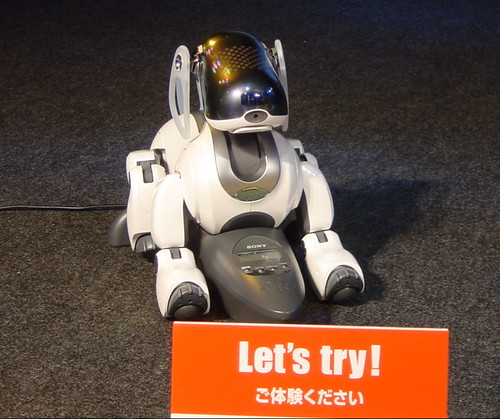
I was sad to see the news that Sony has canned it's Aibo robotic dog.

One of the highlights of a trip to Japan a couple of years ago was seeing a demonstration of the QRIO biped robots in the Sony Store. By coincidence, I put a rather poor movie I made from my digital camera (Sony) on my iWeb test personal website just a couple of weeks ago, showing these in action (I've now added a couple of photos too on the photos page). While it may not be obvious, these robots are incredibly clever. I believe they are the first 2 legged robots which are able to stand on one leg, and also to get up themselves after falling over. I have no idea how much effort was required to get them to perform the synchronised act in the movie, or how close they were to enabling domestic use, but the demonstration had everyone smiling. I haven't seen anywhere whether the Aibo announcement also includes halting work on QRIO or other derivatives, but I assume it's not good news in this regard.


Sony has received a fair amount of negative publicity recently - the DRM rootkit debacle, Sony's Connect software failing, etc. As a company, they have gone down significantly in my estimation because of these anti-consumer/user actions. But everytime I see this movie or see news of Aibo, I was always more forgiving.

I understand Sony may have valid business reasons for the decision. But I can't help feeling that there have been considerable benefits to the overall Sony brand from Aibo and QRIO. Showing you have a fun side (as well as great R&D) makes you stand out next to your competitors like Panasonic, Samsung etc. It is these companies that will welcome Sony's decision most. For those that enjoyed Aibo and/or QRIO, we have just a little less to smile about and a little less admiration for Sony.

27 January 2006

Three articles you should read

Not much time over the next few days, so posting will be a bit light.

But here are three articles you should read and perhaps delve into.

The first is on some new US proposals for faster processing of people through security checks in airports, providing they have signed up for it under the guise of the Registered Traveler Program. Covered here at ArsTechnica, this is just a BAD, BAD, BAD idea for so many reasons. I hope it doesn't happen here, but I'll be the first to write to my MP if it does.

The second is some coverage of the Google foray into China which has been heavily criticised - especially coming in the same week that they seek to gain positive publicity by shunning a US government request that is in fact far more innocuous. I am really disappointed in Google for this. But I think again Ars' coverage is right (which is why I've used that particular link). Surely the issue here is that ALL our companies should be held to such standards? Google would be seriously disadvantaged when compared to its Western peers. I don't think it excuses their behaviour entirely, but it is time for governments to stand up to this.

Finally, some more Ars coverage on a BBC project to have the music industry answer questions. It is very enlightening and, indeed worrying. I'd like to think it backs up many of the postings I've made here. As consumers we need to start making our voices heard.

26 January 2006

The Value of Market Research (Not)

Although these two bits of research are Apple-related (and why they drew my attention) the points I want to make are about the complete uselessness of the research and how I see it only leading to stupid conclusions.

First up is this story picked up by (among others) the BBC, and read by lots of people as a consequence. Let's concentrate on the following statement which was almost portrayed as the most interesting bit of the survey in the BBC's eyes (and a few others too)

For instance, Nielsen said, iTunes users were 2.2 times more likely to own a Volkswagen than the average internet user. Audi and Subaru were also popular with regular users of the Apple store.

The research also revealed that the most popular alcohol drink was cider followed by imported beers. Top magazine among iTunes fans was hi-tech bible Wired.


This comes from the same Nielsen who I found this week
The company's ratings are extrapolated from the viewing habits of 9,000 households, of which only 60 have DVR's.


I don't know about you, but reading that made me seriously question the validity of any of their research!

Back to the iTunes research... the key finding that struck me as bizarre is that Cider is the favourite alcoholic drink, followed by imported beer. I'm sorry, but there is no way that this makes any sense! If the survey was done just in the US, (when I lived there cider was a very, very infrequent drink at least in alcoholic form - though apple juice was sold as cider), I believe it even less. Even in the UK and Ireland, cider's market share is below 10% of "long alcoholic drinks". Now, if the question had been asked such as what is your favourite alcoholic drink:
a. Bud
b. Bud Light
c. Miller
d. Coors
e. Miller Light
f. Other american beer
g. Imported beer
h. Cider
Perhaps I could see how cider might come close to being dominant (but I'm still not sure). Otherwise, this result is completely bogus.

As for the Volkswagen finding, well, VW's market share in the US is what? 3%? 5%? So, how many people do you need to survey to get something significant like the fact that iTunes users are 2.2x likely to drive VW's? And is it any surprise? I'm sure not so many drive Oldsmobiles or Cadillacs. VW's are often the cars of the young in the US and in the more liberal (iPod-loving!) states anyway.

No, this research is completely useless (at least the way it has been portrayed). It is research that is done and publicised not for value but purely to push your own name out to the world.

Next up, is this piece of garbage reported by, among others, CNet

Admittedly I'm not the first to pan this, though I can't find the links. But essentially they claim that iWork has now taken 2nd spot in the Office software market after Microsoft Office, with a 2.7% market share. Anyone with an inkling of knowledge about market shares knows this cannot be true. Firstly, iWork does not have a spreadsheet application, so personally I don't believe it should be categorised in with these suites. But even if you count it, Apple's market share even in the US is, what, 5%? That implies at least half of all Apple users are using iWork instead of Office. And I do not believe for one minute that is true. I know of few iWork users (I am one). But even many of them would still use Office and particularly Excel some of the time.

I'm sure this story boils down more to bad research - not covering all the channels through which such software is sold (eg OEM, corporate channels), or not covering a long enough time slot (eg software sales will surge after a new release and decline hugely before a new one is expected).

So, to all those quoting these bits of research, please do a bit more investigation into what is being researched, why it is being researched and promoted to you, and whether it really is valid.

Footnote: I would note my part-time involvement in a small internet-based market research company http://www.tpoll.com. I would be horrified if they produced such garbage

25 January 2006

Apple Thoughts and Myths/Realities Follow-up

I've been working on a number of pieces since the MacWorld article, and the Apple financials, but they've usually been usurped by something else I've read which is much better (and usually more concise) than I can possibly write. So, instead, I'm going to provide a few links to the more interesting comments, and also summarise my current thinking as regards Apple's challenges ahead. This is still going to be a very long article, but hopefully will cover a lot of ground.

I felt leading up to MacWorld that expectations had got far ahead of what could reasonably be delivered. I analysed views relating to Timing, Pricing, Performance and Functionality, and felt that, on balance, there could only be disappointment. And I think in general among the Mac Faithful, there has been an unusual amount of negative postings (example: see O'Grady Powerpage posting today). Many of these are so at odds with each other, that it perhaps highlights that Apple probably got it about right!

Let's talk about the new machines first. As I mentioned at the time, most forecasts were for the lower end machines to get upgraded to Intel first. While I hedged a bit here (expecting Apple to only use a dual core chip in some up-market new product), I succumbed to their overall views. In the end, Apple surprised (most of) us by releasing the mid-range higher margin machines first - iMac and MacBook Pro. In my myth/reality series, I had highlighted the problems of introducing the low-end machines first. So, business-wise, Apple took the right decision, though more on the risks, later. I was hoping to have some informed insight on the new machines, and some comments on what I felt were some silly objections. But instead, I'm going to refer you to the excellent Mr John Gruber's Daring Fireball blog (currently the first article) where he has provided a really good commentary on the new machines. Please also read his comments on the ridiculous iSuppli analysis on cost of an iMac that has been given over-coverage by some of the press.

There have been all sorts of comments on the price of the new machines, their performance, etc and I want to cover some of these a bit below - as they relate to the myths/realities I posted before.

On balance I think Apple provided a very solid engineering solution way ahead of the time they had originally outlined, and indeed brought forward the migration across the whole range. They used current designs for the most part which some feel is very unambitious. But in doing so, that also provides a comfort factor to many of the faithful. And I think many people truly underestimate how much work was involved in the migration and what compromises had to be made. Changing the form factors would have been extremely risky, and probably unnecessary. The iMac and MacBook Pro (ex-Powerbook) form factors are generally best-of-breed still and are relatively well-tested in the field. The changes to the MacBook Pro are generally forward looking rather than mean - at the end of the day there's more in this machine than there is today, without accounting for the performance leap.

So, let's take a look at the myths/realities in more detail.

1. Timing. I had bet we would have Intel Macs and we do. And, as I mentioned above, financially-speaking, these are the right machines to do first. Apple has also announced the whole transition will be completed by the end of this calendar year - about 12 months earlier than originally planned. This is great - it reduced the period of uncertainty for many and for Apple as a company. But it will also place great strain on the resources of the company this year, and the effects of the uncertainty may be magnified, even as the timing is reduced. As I will cover in the financials review later, this is going to be a rocky year.

2. Pricing.
I have seen so much poorly written stuff on pricing that it is hard to know where to begin. I had written that an advantage of the move in the end would be transparency with the competition, and I'd hoped this would paint Apple in a more rosy picture. But for everyone who can do a price comparison, there's several who can't. There is little to compare to an iMac, save a desktop all-in-one Sony Vaio. But for the MacBook Pro, there are already several PC competitors out there, including models from Dell, Acer, Lenovo, HP and Gateway. I have looked in detail at many of these offerings, and I have to say that Apple has priced the new MacBook Pro positively and reasonably. As I originally mentioned for every machine an Apple compares favourably to in the PC World, there will be many others seemingly priced better. You want a 15" windows laptop - there are hundreds to choose from. You want a 15" Apple laptop, and there is just one. But if you look at the other models and what they offer, the Mac does NOT carry a price premium anymore than a good Dell (and less than a Dell XPS?) or a good Thinkpad. Of course, if you didn't want that level of finish/features, then it might be out of your price bracket. But please don't call it expensive, when it's not for what it includes and relative to similarly-equipped other models. A key observation I made was that the MacBook appears to be 1lb lighter - or about 20% - than any other 15" widescreen model I saw. (and a word to UK observers, please, please please price in VAT when you do comparisons. How many times do I have to tell you!).

3. Performance.
This is an area where I've been equally disappointed with what I've read. While I had suggested that performance wouldn't be earth-shattering, I had written this on the basis that it would be low end machines first. Instead, Apple has taken the mid-range machines and turned them into potentially PowerMac killers. I say "potentially" because there are several caveats I will come to. So, let's see what some people have said:

Let's go to The Register first to see how it covered a report produced by MacWorld.

This is a really poor report and they have gone down significantly in my estimation on this article alone. For instance, they quote 4 times as the benchmark expectation. That is ridiculous. Apple claimed that the iMac was 2-3 times faster on certain benchmarks demonstrating the theoretical performance of the insides. At the same time it showed other stats demonstrating that real world (native) applications could be as much as 1.9 - 2.6 times faster. SJ also pointedly noted at the keynote that real world speeds would be affected by many other circumstances such as RAM, hard disk speed, application type etc. Steve also deliberately showed Photoshop working under Rosetta and demonstrated that it was usable but on balance slower than on a G5. So, for the iMac, Apple's position has reasonably been to expect some aspects of performance to be about 2x better, and overtime for that performance improvement to apply to other applications. So, let's look at the other part of the Register story - that it is in fact just 1/4 faster or 25%. (Incidentally, a figure that is not in the least embarrassing given that the iMac already used a fast G5 chip, and is priced at the same price as it's predecessor). To look at the 1/4 claim, let's go to the MacWorld story itself.

Jason Snell, MacWorld editor has in fact done quite a commendable job and he has suffered a lot of abuse over the article. Some of it's his own problem by failing to comprehend the concept of percentages. He has fortunately corrected that in the article you will read, but not all coverage reflects that. Currently headline figures show performance improvements of zero to 1.84 times (with one slightly negative figure). So, Andrew Orlowski's headline figure is just that - a generalisation he has pulled out of the air to prove a cyncial point. While Jason's article is more detailed than many and he has tried to offset some issues, I think the problems are clear if you can be bothered to wade through the comments left by some observers. Let me summarise some though:

a. Dual core tests. Almost none of MacWorld's tests will have tested the dual core performance of the machine, on which a lot of Apple's claims rest. Perhaps the one test to do this is the boot up test, as we assume Apple has managed to optimise some of Mac OS 10.4.4 to use a dual core when on offer. In this regards a 1.84x improvement is pretty decent - especially considering disk and RAM will play a part in this too. While some may claim dual performance isn't reasonable, I would say it very much is. Increasingly we are really using our machines to do many things - some in the background. Converting a video to MPEG 4 for iPod while browsing and having an iChat are good examples of things we are all doing more and more. I'm surprised that MacWorld didn't design the tests to show how things work better (assuming they do) when we're doing more than one thing - which is when we probably most want the performance improvement.

b. RAM. While it may of course be fair to use the stock RAM (512MB) in both test machines, the level of RAM chosen seems strange given the design of many of the tests. Many media tests and certainly Photoshop tests will be RAM constrained on a 512MB system. I would imagine Rosetta would only serve to squeeze that more (though it would be unreasonable to compare a 1GB Intel iMac with a 512MB G5 iMac). But given that SJ said other factors came into it, I would have thought MacWorld could have designed the tests a little better to isolate the effect of RAM on such tests.

c. Scenarios used. The MacWorld tests were limited to a few scenarios which are overly focused on just a few applications, and do not focus on what people do much of the time. For instance, why not cover application loading time? Why not cover page rendering time for websites? Another way to look at performance would have been to see the free CPU available when running tests. I have seen reports of HD replaying that are very positive indeed - putting a MacBook Pro (pre-production) easily on a par with a dual core G5 PowerMac, for instance (40% overall CPU usage vs 55% for full frame performance). While graphics card changes might help with this test, these are important numbers - especially going forward.
On another review of the iMac, David Pogue
at the NYTimes
quotes a massive speed improvement - certainly of the order of 2x for page rendering and application start-up. While I'm not sure of the scientific nature of these tests, these strike me as more meaningful than the MacWorld tests.

d. Last but not least, on performance, I am really surprised that we have not seen some performance comparisons between Windows machines and the iMac. There are some Yonah-based laptops around that could be compared with an iMac. Or use a Pentium D or something similar in price. iTunes would be a good application to compare against. Boot up times, wake from sleep, times to duplicate files etc, would all be interesting benchmarks, as would HD playback or other Quicktime tests. In the end, these are the tests that will determine whether the Mac succeeds or not.

And, in the end, this story is only going to improve from here. We'll have more native applications, and more optimisation for Intel via improved compilers and code improvements as people become familiar. And later this year, we'll be moving towards the first 64-bit dual core chips. Finally, remember Steve's reason for moving to Intel was performance per watt, not absolute performance. By all accounts the new iMacs are very quiet which implies lower heat even with 2 cores versus single core G5.

As an aside here as well, it's worth commenting on Rosetta. The reports in so far seem to indicate that this has been indispensable technology to Apple in achieving this switch. Performance numbers combined with excellent application compatibility are really good stories and have been frequently overlooked.

So, I can summarise this by stating that I believe the performance numbers are looking pretty good already, and this performance combined with lower power consumption will provide Apple a springboard to introduce the great new leaps forward in functionality that some expected would come immediately with the shift to Intel. Don't believe all that you read unless you really dig deep (read the comments if they're available). And in the end, don't compare an old Mac to a new Mac - compare it to a Windows box as that's what is going to count long term. I don't know how they would stack up, but I can't believe that Steve made this move without believing that Mac OS X shows up pretty well against Windows.

4. Functionality. - the final one of the four myths/realities. I think many were disappointed that MacWorld did not herald a great leap in functionality - into the living room for instance, or perhaps a well-rounded iWork suite including a decent spreadsheet. We got very little other than an improved iWork and iLife. I have covered iLife a little here already and maintain a generally positive view on it (though feel iWeb is still very much a v0.9 application). I am using iWork but not in anger yet, so can't comment too much. With the hole left by Appleworks not being made available on the Intel Macs, I think Apple has a problem in providing a complete Home Office package competing with all-in-one packages available on the Windows platform and often included in the low end machines. Hopefully it has something up its sleeve to fill this void. But more importantly, what happened to the convergence functionality being expected? Some people expected an Apple DVR. Some (me included) expected a video-capable Airport Express. Others expected FrontRow to be made available across the range of Macs (though I think this is just a slightly cynical marketing move).

There have been reports that the MacWorld keynote was changed at the last minute with some key announcements dropped. It's difficult to know how true this is - especially as the keynote was already significantly longer than previous ones. In the end, I think Apple's MacWorld was indeed conservative but partly because it had to be. SJ made a deliberate statement about it being MACWorld, not iPodWorld. He focused his major announcements on the Mac platform, and hopefully re-assured the faithful that Apple's strategy is about Macs and Mac OS more than it is about the iPod which could be a transient (though, of course, huge) phenomenon. The conservative introductions (form-factor-wise of the new Macs) showed it was taking the migration seriously - not flippantly. It is also possible that some things were just not ready for primetime. The video airport express for instance might be dependent upon 802.11n - the next generation wireless specification. It had been expected this would be finalised last year, but in fact, it is only in the last week that this has happened. While Apple has always been at the forefront of wireless adoption, I think it could not afford to announce products at that time - and probably didn't need to. With the finalisation of this spec, I think we can expect an Apple announcement about using it within the next 3 months. I'm sure 802.11n is a vital part of Apple's whole-house strategy. But, if so, it also belongs with announcements about affordable home Macs - including iBook and Mac mini updates. The pieces are appearing - remote controls for new Macs, FrontRow, iSight built-in, Photocasting directly, more display connections (in the iMac)... The big missing piece though remains Apple's ability to incorporate broadcast/cable TV into the platform. I did not expect an Apple DVR this time round, and I don't underestimate the difficulties of doing this across the many technologies of terrestrial, cable and satellite in multiple world markets. But eventually, Apple must bite the bullet on this and make this an integral part of the Mac-in-the-home experience.


Financials

Finally, I'd like to wrap this analysis up with some commentary on the financials. Apple's numbers for the last quarter were staggering. Over 14million iPods sold is an incredible achievement, especially considering previous problems with inventory on new models (eg iPod mini). (As an aside, I believe Sony Ericsson shifted about 14million phones in the quarter, so that demonstrates the scale of this achievement) And the Mac numbers too were on balance very good. Year-on-year Mac shipments up 19%, and Mac revenue up 7.5%, with record Mac sales. Over 2 years, Mac shipments are now up over 51%. Most PC companies would kill for such numbers. But, in reality the growth was much reduced from the previous quarter and started to show that people were indeed holding off. Did Apple see this coming and cause it to concentrate on the higher end machines first? I'm not sure, as looking back, it is obvious to see that it is the dual core variants of Yonah that are in supply first and that these were always going to find their way into high end machines.

But, one does wonder whether Apple is responding to this dip rather than leading it. Furthermore, the next quarter's predictions - while a Q2 record if they're hit - are not awe-inspiring. Personally, I think they may struggle to hit even these numbers. iPod shipments in the final quarter benefitted hugely from the holiday season and the release almost simultaneously of major improvements in the product. As the market matures the buyers become less "influencers" and more "influenced". The latter category are more likely to concentrate their purchases around events such as Christmas or birthdays. I know many people who bought one or more iPods last quarter. I know of no one who has bought one or who is contemplating one this quarter.

So, I think we'll see a return to more normal levels (if 6 million a quarter can be described as normal). Mac sales I'm particularly worried about. Apple cannot begin shipping MacBook Pros until at least mid-quarter. I know many people who will hold off from the first release (though I've seen anecdotal evidence of many switchers stating their intent to buy). As for the iMac, it's not clear whether they'll either have enough, or whether the first release will attract more people than it loses due to initial compatibility and overall FUD factor. iBooks, and minis will barely shift, and even Powermac sales may be disrupted now people know what the Intel Macs can do, and know that new Intel-based Powermacs will be available starting this year - not the end of next year.

Of course, Apple will have achieved its transition to Intel completely by the time Microsoft is shipping Vista, and the importance of that as people make buying decisions cannot be underestimated. I also think we'll see some block-buster products this year - with new form factors and functionality following on behind successful product transitions. Apple had a window (sorry) in which to do all of this, and so far, they're doing really well on that. But the halo effect can be easily dented and much harder to re-light. And I find it slightly ironic that just as Apple is executing better than ever (eg iPod fulfillment, first Intel macs ahead of expectations) there are rumblings among the Mac faithful (perhaps encouraged by others who'd like to see Apple fail) whose expectations seemed to reach beyond what even Steve's infamous Reality Distortion Field (RDF) could conjure up this time round.

Here's the reality folks, and you should be enjoying and revelling in it: Apple is delivering well on products; it is transitioning faster and with the products needed; the performance numbers ARE good and even more so looking ahead; the compatibility backwards is also good; and it is maintaining and even growing its leadership in digital music. All-in-all what a strange time for Steve's RDF to evaporate!